

 You need clarity before you spend money on a new idea. Many founders rush forward without proof of demand. As a result, they risk wasting time and capital. When you understand how to validate a business idea, you protect your investment early.
First, you must confirm that a real problem exists. Then, you need evidence that people will pay for a solution. Without that proof, your concept remains an assumption. Therefore, validation becomes your first and most important step.
Moreover, validation helps you refine your direction before scaling. Instead of guessing, you make decisions based on real feedback. As a result, you avoid costly mistakes and improve your chances of success. At the same time, you gain insight into customer behavior and expectations.
Next, you should treat validation as an ongoing process. You test ideas, gather responses, and adjust your approach. This cycle builds confidence in your concept. Meanwhile, it reveals gaps that you might not notice otherwise.
Ultimately, your goal is to reduce uncertainty before investing heavily. You want to confirm demand, pricing, and positioning early. When you follow a structured validation process, you build a stronger foundation. As a result, your business starts with clarity, not guesswork.
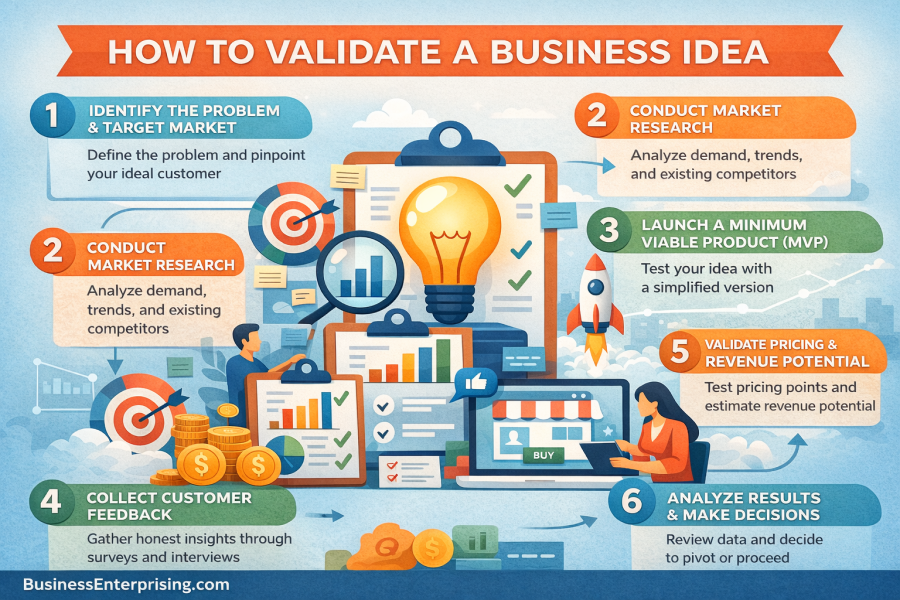
Identifying the Problem and Target Market
First, you need to define the problem your idea solves. Without a clear problem, your concept lacks direction. Therefore, you must focus on a specific pain point that affects real people. When you understand the issue, you can create a solution that matters.
Next, you should identify your target market with precision. Broad audiences lead to weak positioning. Instead, you want to define your ideal customer in detail. Consider their needs, habits, and purchasing behavior. As a result, your messaging becomes more effective.
Moreover, you should engage directly with potential customers. Conversations reveal insights that data alone cannot show. When you listen closely, you learn how people describe their challenges. This insight helps you refine your idea.
At the same time, you need to test your assumptions. Many founders believe they understand their audience, yet they rely on guesses. Instead, you should validate each assumption with real feedback. This approach strengthens your foundation.
When you apply how to validate a business idea at this stage, you confirm both the problem and the audience. As a result, you reduce risk early. You also create a clear path for development and marketing.
Conducting Market Research and Competitive Analysis
First, you need to understand the size and demand of your market. Without this insight, you cannot estimate growth potential. Therefore, you should analyze trends and customer behavior. This research helps you see where opportunities exist.
Next, you must evaluate your competitors. Every idea exists within a competitive environment. When you study competitors, you learn what already works. At the same time, you identify gaps that others have missed.
Moreover, you should review pricing, positioning, and messaging. Competitors reveal how the market responds to different approaches. As a result, you can adjust your strategy before launching.
Then, you should assess customer reviews and feedback. These insights highlight strengths and weaknesses in existing solutions. When you analyze this information, you gain a clearer picture of customer expectations.
When you apply how to validate a business idea through research, you reduce uncertainty. You also gain confidence in your direction. As a result, you make informed decisions rather than relying on assumptions.
Testing Demand with a Minimum Viable Product (MVP)
First, you should create a simplified version of your idea. This version focuses on core features only. As a result, you reduce development time and cost. At the same time, you test real demand quickly.
Next, you need to present your MVP to your target audience. This step allows you to observe real behavior. Instead of relying on opinions, you measure actions. Therefore, you gain more reliable insights.
Moreover, you should track engagement and usage patterns. These metrics show how people interact with your product. When users engage consistently, you know your idea has potential.
Then, you must remain open to feedback and adjustments. Your MVP is not a finished product. Instead, it acts as a testing tool. When you refine based on data, you improve your concept.
When you use how to validate a business idea through an MVP, you test demand efficiently. As a result, you avoid large upfront investments. You also gain clarity on what customers truly value.
Gathering Feedback from Potential Customers
First, you should collect feedback from real users. Surveys and interviews provide valuable insights. When you ask direct questions, you learn how people perceive your idea.
Next, you need to focus on honest and detailed responses. Positive feedback feels good, yet critical feedback drives improvement. Therefore, you should encourage open and candid input.
Moreover, you should analyze patterns in responses. Individual opinions matter, yet trends reveal stronger insights. When multiple users share similar concerns, you identify areas for improvement.
Then, you must test willingness to pay. Interest alone does not confirm demand. Instead, you need proof that customers will spend money. This step strengthens your validation process.
When you apply how to validate a business idea through feedback, you refine your concept. As a result, you align your offering with real customer needs. You also build confidence before investing further.
Validating Pricing and Revenue Potential
First, you need to test different pricing strategies. Pricing affects both demand and profitability. Therefore, you should experiment with various price points. This approach helps you find the right balance.
Next, you should observe customer reactions to pricing. Some customers may show interest yet hesitate to purchase. This hesitation often signals pricing concerns. As a result, you gain insight into perceived value.
Moreover, you should compare your pricing with competitors. Market benchmarks provide useful context. When you understand pricing trends, you position your offer more effectively.
Then, you must estimate revenue potential based on demand. This step helps you determine whether your idea is sustainable. When projections align with market data, your concept becomes more viable.
When you use how to validate a business idea for pricing, you confirm financial feasibility. As a result, you avoid underpricing or overpricing your offer. You also build a stronger business model.
Analyzing Results and Making Data-Driven Decisions
First, you need to review all collected data carefully. Each insight contributes to your overall understanding. When you analyze patterns, you gain clarity on your idea’s potential.
Next, you should compare results against your initial assumptions. This step reveals gaps in your thinking. When assumptions do not match reality, you adjust your approach.
Moreover, you must decide whether to move forward or pivot. Data provides direction, yet you must act on it. Therefore, you should evaluate demand, feedback, and financial potential together.
Then, you should refine your strategy based on findings. This process strengthens your business foundation. When you make informed adjustments, you improve your chances of success.
When you apply how to validate a business idea through analysis, you make smarter decisions. As a result, you reduce risk and increase confidence. You also position your business for sustainable growth.
FAQ
| Question | Answer |
|---|---|
| Why is validation important before starting a business? | Validation helps you confirm that your idea solves a real problem and has demand. It reduces financial risk and prevents wasted time. When you test your concept early, you gain insight into customer needs and improve your chances of building a profitable business. |
| How long does it take to validate a business idea? | The timeline varies based on your approach and industry. Some ideas can be tested within weeks using simple methods. Others may take months for deeper research. The key is to gather enough data to make informed decisions before investing heavily. |
| What is the easiest way to test demand? | Creating a simple MVP or landing page is often the fastest method. You can measure interest through sign-ups, inquiries, or pre-orders. These actions provide real data about customer intent and help you understand whether your idea has potential. |
| Can I validate a business idea without spending money? | Yes, you can validate an idea using low-cost or free methods. Surveys, interviews, and social media engagement offer valuable insights. When you focus on customer feedback and behavior, you can learn a great deal without a large investment. |
| What are the signs that an idea is worth pursuing? | Strong interest, positive feedback, and willingness to pay are key indicators. When customers engage consistently and show intent to purchase, your idea gains credibility. Learning how to validate a business idea helps you recognize these signals and act with confidence. |