 You have likely heard the phrase generative vs. agentic AI, yet the distinction often remains unclear in business discussions. However, this difference matters because it shapes how you apply AI across operations, marketing, and decision-making. Therefore, understanding these models helps you choose tools that match your goals and resources.
Generative AI focuses on creating content based on patterns learned from data. For example, it can produce text, images, or code from prompts you provide. Meanwhile, agentic AI goes further by acting on goals and completing tasks with minimal input. As a result, businesses begin shifting from passive tools to systems that take initiative.
Additionally, you must consider how each type fits into your workflows. Generative systems support creativity and speed, while agentic systems support execution and coordination. Because of this, your strategy should reflect how much autonomy you want from AI tools.
Moreover, businesses now face pressure to adopt AI in ways that produce measurable results. Therefore, clarity around these two approaches becomes essential for making informed decisions. You need to understand where automation ends and where autonomy begins.
Consequently, this article explains how each model works and where each delivers value. You will also see how these technologies interact and where they overlap. By the end, you will better understand how to apply AI in practical business scenarios.
DEFINING GENERATIVE AI AND AGENTIC AI
Generative AI creates content by predicting patterns from existing data. For example, you can ask it to write emails, generate reports, or design visuals. Therefore, it works best when you need fast output based on structured input. You remain in control because the system responds to your instructions.
However, agentic AI operates with a different purpose. It does not wait for every instruction. Instead, it sets goals, makes decisions, and executes tasks across multiple steps. As a result, it acts more like a digital assistant that manages workflows. You define the objective, and it determines the process.
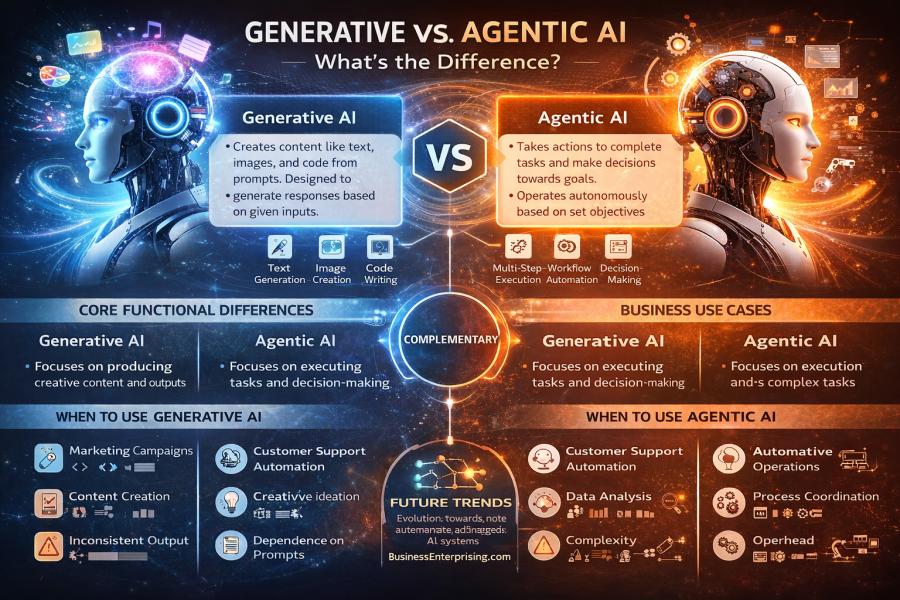
Additionally, generative vs. agentic AI highlights a shift from response to action. Generative tools answer prompts, while agentic systems complete tasks. Because of this, the level of autonomy becomes the defining factor between the two. You move from creation to execution.
Moreover, agentic systems often integrate with tools, databases, and external systems. Therefore, they can perform actions like scheduling, data analysis, or task coordination. This capability allows businesses to reduce manual intervention.
Consequently, your understanding of these definitions shapes how you deploy AI. You must decide whether you need output generation or task completion. That decision influences your technology stack and workflow design. Over time, both approaches will likely work together within your business.
CORE FUNCTIONAL DIFFERENCES IN REAL-WORLD APPLICATIONS
You will notice clear differences when applying these systems in business environments. Generative AI supports content creation tasks such as marketing copy, blog writing, and email drafts. Therefore, it helps you scale communication without increasing staff.
However, agentic AI focuses on executing workflows. For example, it can manage customer inquiries, route tasks, or automate decision processes. As a result, it reduces operational friction and improves efficiency. You gain more than output, you gain action.
Additionally, generative vs. agentic AI becomes evident in customer service. Generative tools respond to questions, while agentic systems handle entire conversations and follow-up actions. Because of this, agentic systems deliver a more complete experience.
Moreover, in operations, generative AI supports documentation and reporting. Meanwhile, agentic AI can analyze data and trigger actions based on results. Therefore, one supports insight, while the other supports execution.
Consequently, your choice depends on your business priorities. You may need content at scale, or you may need automation across systems. In many cases, combining both approaches creates the strongest outcome. You generate ideas and then execute them through autonomous processes.
HOW AGENTIC AI BUILDS ON GENERATIVE AI CAPABILITIES
Agentic AI often relies on generative models as a foundation. For example, it uses generative capabilities to create responses, analyze text, or interpret instructions. However, it extends beyond this by adding decision-making layers.
Additionally, generative vs. agentic AI shows how one evolves into the other. Generative systems provide intelligence, while agentic systems apply that intelligence toward goals. Therefore, agentic AI becomes a more advanced application of existing capabilities.
Moreover, agentic systems break tasks into steps and execute them sequentially. They evaluate outcomes and adjust actions as needed. As a result, they function more like a process manager than a simple tool. You gain adaptive behavior rather than static responses.
Furthermore, these systems can interact with multiple tools at once. For example, they can gather data, analyze it, and then act on the findings. Therefore, they bridge the gap between insight and execution.
Consequently, you should view agentic AI as an extension rather than a replacement. It builds on generative capabilities while adding autonomy and structure. Over time, businesses will increasingly adopt systems that combine both approaches for greater efficiency.
BUSINESS USE CASES: WHEN TO USE GENERATIVE VS. AGENTIC AI
You should choose generative AI when your focus is content creation. For example, marketing teams use it for blogs, ads, and email campaigns. Therefore, it helps you produce consistent output quickly.
However, agentic AI works best when tasks require coordination and execution. For instance, it can manage workflows, handle customer interactions, or automate internal processes. As a result, it reduces manual work and increases consistency.
Additionally, generative vs. agentic AI depends on the complexity of the task. Simple tasks benefit from generative tools, while complex workflows require agentic systems. Therefore, you must evaluate the scope of each use case.
Moreover, in sales, generative AI can draft outreach messages. Meanwhile, agentic AI can manage follow-ups and track responses. Because of this, combining both creates a more complete system.
Consequently, your strategy should align with your business goals. You may start with generative tools and expand into agentic systems over time. This progression allows you to scale capabilities without overwhelming your team.
BENEFITS AND LIMITATIONS OF EACH APPROACH
Generative AI offers speed and flexibility. You can create content quickly and adapt it to different needs. Therefore, it supports rapid experimentation and scaling. However, it depends heavily on user input.
Additionally, agentic AI provides automation and independence. It can complete tasks without constant supervision. As a result, it improves efficiency across operations. You reduce the need for manual intervention.
However, generative vs. agentic AI also reveals limitations. Generative systems may produce inconsistent results without clear prompts. Meanwhile, agentic systems require careful setup and monitoring. Therefore, each approach carries different risks.
Moreover, agentic systems can introduce complexity. They interact with multiple systems and require proper oversight. Because of this, businesses must manage them carefully to avoid errors.
Consequently, you should weigh benefits against risks before implementation. Generative tools offer simplicity, while agentic systems offer power. Your decision should reflect your readiness for automation and your tolerance for complexity.
FUTURE TRENDS: THE EVOLUTION TOWARD AUTONOMOUS AI SYSTEMS
Businesses continue moving toward more autonomous systems. Generative tools laid the foundation by enabling content creation at scale. However, the next phase focuses on execution and decision-making.
Additionally, generative vs. agentic AI represents this transition clearly. You move from tools that assist to systems that act. Therefore, businesses gain new levels of efficiency and scalability.
Moreover, companies will increasingly integrate AI across departments. Agentic systems will manage workflows, analyze data, and coordinate actions. As a result, operations become more streamlined and responsive.
Furthermore, this shift will change how teams work. Employees will focus more on strategy and oversight rather than repetitive tasks. Therefore, AI becomes a partner in execution rather than a support tool.
Consequently, businesses that adopt these systems early may gain a competitive edge. You will operate faster and with greater consistency. Over time, autonomous systems will become a standard part of business infrastructure.
CONCLUSION
You now have a clear understanding of generative vs. agentic AI and how each functions in a business context. Generative systems focus on creating content, while agentic systems focus on completing tasks. Therefore, each serves a distinct role.
Additionally, your success with AI depends on choosing the right approach for your needs. You may begin with generative tools to improve productivity. However, you can expand into agentic systems to automate workflows.
Moreover, combining both approaches often produces the strongest results. You generate ideas and then execute them efficiently. As a result, your business gains both speed and structure.
Consequently, you should evaluate your current processes and identify areas where AI can add value. Start with clear objectives and build from there. Over time, you will develop a system that supports both creativity and execution.