

 Running a business often feels overwhelming when daily tasks consume your time and attention. However, learning how to automate your business can change how you operate and grow. You gain back hours while keeping your operations consistent and efficient. As a result, you can focus on strategy, revenue, and long term growth.
Moreover, many business owners spend time on tasks that do not require deep thinking. These tasks often include scheduling, responding to emails, and managing data. When you rely on manual work, you limit your ability to scale. Instead, automation allows your systems to handle repetitive work with accuracy.
In addition, automation creates consistency across your processes. You reduce human error while improving speed and reliability. Because of this, your customer experience becomes more predictable and professional. At the same time, your team can shift their attention toward higher value activities.
Furthermore, automation does not require complex systems to start. You can begin with simple tools and expand as your needs grow. Over time, these improvements compound and deliver significant time savings. As a result, you build a business that runs smoothly without constant oversight.
Ultimately, automation gives you control over your time and operations. You move away from reactive work and toward intentional growth. When you apply the right strategies, your business becomes more scalable and efficient.
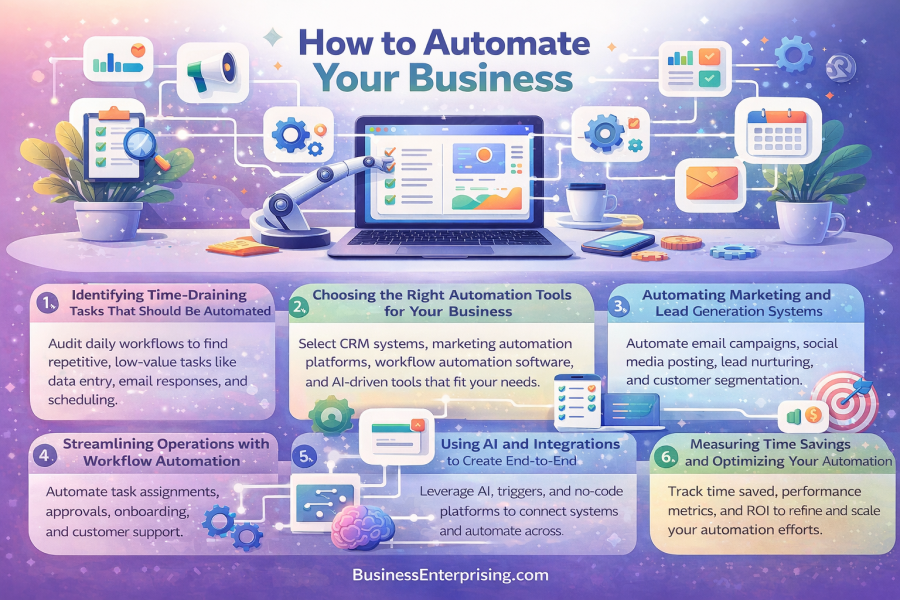
Identifying Time-Draining Tasks That Should Be Automated
To begin, you need to understand where your time goes each day. Start by reviewing your daily and weekly workflows in detail. As you track your activities, patterns will quickly become clear. You will notice tasks that repeat and consume valuable hours.
Next, focus on identifying low value work that does not require strategic thinking. Tasks like data entry, email replies, and scheduling often fall into this category. Because these tasks are repetitive, they are ideal for automation. As a result, you free up time for more important responsibilities.
Moreover, pay attention to bottlenecks that slow your operations. For example, manual reporting or approval processes can delay progress. When these delays occur often, they impact productivity across your business. Therefore, automation can remove these friction points and improve workflow speed.
In addition, consider how often errors happen during manual processes. Repetitive tasks increase the chance of mistakes over time. By automating these tasks, you improve accuracy and consistency. This leads to better outcomes and fewer corrections later.
As you evaluate your workflows, prioritize tasks that consume the most time. Focus on areas where automation can deliver immediate value. While small improvements help, high impact changes create noticeable results.
When you understand how to automate your business, you start by eliminating unnecessary manual work. Over time, this shift allows you to operate more efficiently and with greater focus.
Choosing the Right Automation Tools for Your Business
Once you identify tasks to automate, the next step involves selecting the right tools. Many options exist, so you need a clear approach. First, define your business goals and operational needs. This clarity will guide your decisions.
For example, CRM systems help manage customer relationships and sales pipelines. Meanwhile, marketing automation platforms handle email campaigns and lead nurturing. Workflow automation tools connect processes across departments. AI driven tools also assist with content, analysis, and decision support.
As you evaluate tools, consider how well they integrate with your existing systems. Strong integrations reduce manual work and improve data flow. Therefore, choose tools that connect easily with your current setup. This will save time during implementation.
In addition, assess ease of use and learning curve. Complex tools can slow adoption and create frustration. Instead, select platforms that your team can use confidently. This encourages consistent use and better results.
Furthermore, consider your business size and growth plans. Some tools work well for small teams, while others scale with larger operations. As your business grows, your tools should support expansion without major changes.
When you learn how to automate your business, tool selection plays a major role in success. With the right platforms, you build systems that run smoothly and support long term growth.
Automating Marketing and Lead Generation Systems
Marketing often requires consistent effort, which makes it ideal for automation. To start, focus on email campaigns and lead nurturing sequences. These systems allow you to communicate with prospects without manual effort.
For instance, automated email sequences can guide leads through your sales process. You can deliver valuable content while building trust over time. As a result, you create a steady flow of qualified prospects.
In addition, social media scheduling tools allow you to plan content in advance. Instead of posting manually each day, you can schedule weeks of content at once. This approach saves time while maintaining a consistent presence.
Moreover, automation helps with customer segmentation and targeting. You can group your audience based on behavior and interests. Then, you deliver tailored messages that resonate more effectively. This improves engagement and conversion rates.
Furthermore, lead capture systems can collect and organize data automatically. When someone interacts with your business, their information enters your system instantly. This allows you to respond quickly and efficiently.
As you implement these strategies, you will see how to automate your business in a way that supports growth. Marketing automation creates a predictable system that works continuously in the background.
Streamlining Operations with Workflow Automation
Beyond marketing, internal operations also benefit from automation. Many businesses rely on manual processes that slow productivity. By streamlining workflows, you create a more efficient organization.
For example, task assignments can be automated based on specific triggers. When a project begins, tasks are assigned without manual input. This reduces delays and keeps projects moving forward.
In addition, approval processes can be automated to improve decision speed. Instead of waiting for emails or meetings, approvals happen within a system. This keeps operations running smoothly and consistently.
Moreover, onboarding processes can be standardized through automation. New employees or clients receive the same experience every time. This improves consistency while reducing administrative workload.
Invoicing and customer support also benefit from automation. Automated billing systems send invoices and reminders without manual effort. Support systems can route inquiries to the right person instantly.
As you refine these workflows, you build systems that operate independently. When you understand how to automate your business, you reduce reliance on constant supervision. This allows your team to focus on higher value work.
Using AI and Integrations to Create End-to-End Automation
To take automation further, you can connect systems across your business. Integrations allow different tools to work together seamlessly. As a result, you create end to end workflows that require minimal intervention.
For example, when a lead enters your system, it can trigger multiple actions. The system can assign tasks, send emails, and update records automatically. This reduces manual coordination between departments.
In addition, AI tools enhance automation by handling complex tasks. AI can analyze data, generate content, and provide insights quickly. This allows you to make informed decisions without spending hours on analysis.
Moreover, no code platforms make integrations more accessible. You do not need advanced technical skills to connect systems. Instead, you can create workflows using simple interfaces. This speeds up implementation and reduces costs.
Furthermore, triggers play a key role in automation. These triggers activate actions based on specific events. For example, a completed form can start a follow up sequence automatically.
When you apply these strategies, you see how to automate your business at a deeper level. Integrated systems create a connected environment that supports efficiency and growth.
Measuring Time Savings and Optimizing Your Automation Strategy
After implementing automation, you need to measure its impact. Start by tracking how much time you save each week. This gives you a clear view of your progress.
In addition, monitor key performance metrics related to your processes. Look at response times, error rates, and output levels. These metrics show how automation improves efficiency.
Moreover, evaluate the return on your investment. Compare the cost of tools with the value of time saved. In many cases, automation delivers significant financial benefits over time.
As you gather data, look for areas to improve. Some workflows may need adjustments to perform better. By testing and refining your systems, you increase their effectiveness.
Furthermore, continue expanding automation as your business grows. New opportunities will appear as your operations evolve. By staying proactive, you maintain efficiency at every stage.
When you understand how to automate your business, optimization becomes an ongoing process. Over time, your systems become more refined and reliable. This allows you to operate with greater confidence and control.
FAQ
What is business automation and why should you use it?
Business automation uses software to handle repetitive tasks without manual effort. As a result, you save time and improve consistency. Moreover, automation allows your team to focus on higher value work. When you understand how to automate your business, you create systems that support long term growth.
How do you know which tasks to automate first?
Start by reviewing your daily activities and identifying repetitive tasks. Focus on tasks that consume time but require little decision making. For example, scheduling, data entry, and email responses are strong candidates. By targeting these areas first, you gain quick wins and build momentum.
Do you need technical skills to automate your business?
You do not need advanced technical skills to begin. Many tools offer simple interfaces and guided setup. In addition, no code platforms make automation more accessible. As you gain experience, you can expand into more advanced workflows.
How much time can automation realistically save?
Automation can save several hours each week, depending on your processes. Many businesses report saving 20 or more hours weekly. Over time, these savings allow you to focus on strategy and growth. As a result, your productivity increases significantly.
What tools should you use to get started?
Choose tools based on your business needs and current systems. CRM platforms, marketing automation tools, and workflow software are common starting points. Also, look for tools that integrate easily with your existing setup. This will help you avoid unnecessary complexity.
How do you measure the success of automation?
Track time savings, error reduction, and process speed improvements. In addition, monitor key performance indicators related to your operations. These insights help you understand what works and where to improve.