

 Learning how to build business credit can change how your company grows and scales. Many owners overlook this step early, which slows funding opportunities later. However, strong business credit gives you access to higher limits and better terms. As a result, you gain flexibility to invest in growth without relying on personal funds.
First, you should understand that lenders view business credit as a measure of trust. They analyze your payment history, credit usage, and account activity. Therefore, consistent behavior plays a major role in approvals. At the same time, vendors also rely on these scores when offering payment terms.
Next, you need to separate your personal and business finances. This step helps protect your personal credit while building your business profile. Also, it shows lenders that your company operates independently. As you move forward, this separation becomes more valuable.
Then, you should focus on building credit strategically rather than randomly applying. Many business owners apply too early and receive denials. Instead, you should follow a structured approach that builds credibility over time. Consequently, you improve your chances of securing larger credit lines.
Finally, you should treat business credit as a long term asset. When managed well, it supports expansion, hiring, and new opportunities. More importantly, it gives you leverage when negotiating with lenders. With the right approach, you can grow faster and operate with greater confidence.
Understanding Business Credit: What It Is and Why It Matters
Business credit reflects your company’s ability to borrow and repay money. It operates separately from your personal credit profile. Therefore, lenders evaluate your business risk based on its own financial behavior. This separation helps protect your personal assets over time.
First, business credit reports track your payment history with vendors and lenders. They also include information about credit limits and outstanding balances. As a result, lenders use these reports to assess your reliability. When your history shows consistent payments, your credibility increases.
Next, business credit differs from personal credit in several ways. Personal credit ties directly to your Social Security number. However, business credit links to your EIN and company records. This distinction allows your business to stand on its own financially.
Then, vendors rely on business credit when offering net payment terms. These terms allow you to buy now and pay later. Therefore, strong credit makes it easier to access flexible purchasing options. Over time, this can improve your cash flow significantly.
Also, lenders use your business credit profile to determine loan approvals and limits. They review your payment patterns, account age, and credit usage. When these factors look strong, they offer higher limits.
As you learn how to build business credit, you should focus on consistency and discipline. Every payment and account decision affects your profile. Consequently, small actions can lead to larger opportunities. With steady effort, your business credit becomes a powerful financial tool.
Setting Up Your Business for Credit Approval
Before applying for credit, you need a strong foundation for your business. Lenders review your setup carefully before extending any credit. Therefore, preparation improves your chances of approval.
First, you should form a legal business entity such as an LLC or corporation. This structure separates your personal and business liabilities. As a result, lenders see your business as a legitimate operation.
Next, you need to obtain an Employer Identification Number from the IRS. This number acts as your business tax identifier. Also, it allows lenders to track your business credit activity. Without it, you cannot build a proper credit profile.
Then, you should open a dedicated business bank account. This step keeps your finances organized and transparent. Therefore, lenders can review your cash flow and financial behavior. Consistent deposits and balances help build trust.
In addition, your business information must remain consistent across all records. This includes your address, phone number, and business name. Even small inconsistencies can delay approvals or cause denials.
Also, you should list your business with credit reporting agencies and directories. This visibility helps establish your presence in the financial system. As you continue learning how to build business credit, this step supports your long term growth.
Finally, you should create a professional online presence. A website and business email show credibility. Consequently, lenders and vendors take your application more seriously. With the right setup, you position your business for faster approvals and better credit opportunities.
Establishing Trade Lines and Vendor Credit Quickly
Trade lines form the backbone of your business credit profile. They represent accounts that report your payment activity to credit bureaus. Therefore, opening the right accounts early can accelerate your progress.
First, you should apply for vendor accounts that offer net-30 payment terms. These accounts allow you to pay invoices within thirty days. As a result, you build a payment history without large upfront costs.
Next, you need to choose vendors that report to major business credit bureaus. Not all vendors report your activity. Therefore, you should confirm reporting before opening accounts. This step ensures your efforts contribute to your credit profile.
Then, you should make small purchases and pay invoices early. Early payments signal reliability and discipline. Consequently, your credit profile strengthens faster than with on-time payments alone.
Also, you should maintain several active trade lines rather than relying on one account. Multiple accounts show lenders that you can manage different obligations. This diversity improves your overall credit strength.
As you focus on how to build business credit, consistency matters more than volume. You do not need large purchases to build a strong profile. Instead, steady activity and timely payments create lasting results.
Finally, you should monitor your accounts regularly. Tracking your payment history helps you avoid errors or missed payments. Over time, your trade lines create a solid foundation for higher credit limits and better financing options.
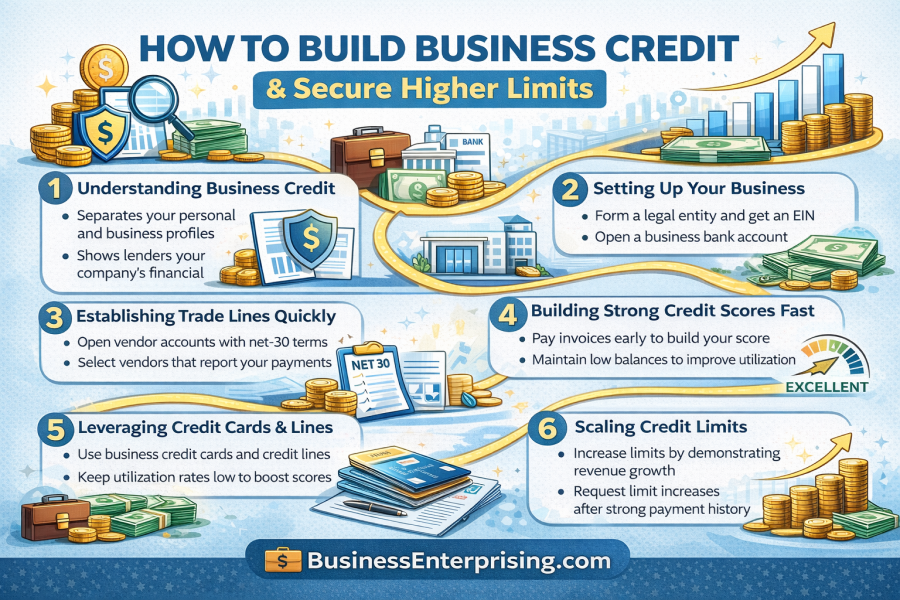
How to Build Strong Business Credit Scores Fast
Business credit scores reflect how well your company manages financial obligations. These scores influence approvals, limits, and terms from lenders. Therefore, improving your score should remain a top priority.
First, payment history carries the most weight in your score. You should always pay invoices on time or early. Early payments often boost your score faster than standard payments.
Next, credit utilization affects how lenders view your financial behavior. You should keep balances low relative to your limits. As a result, your profile shows responsible usage and lower risk.
Then, account age plays a role in your overall score. Older accounts demonstrate stability and consistency. Therefore, you should keep accounts open and active over time.
Also, the number of accounts you maintain influences your score. A mix of trade lines and credit accounts shows diversity. This variety signals that you can handle different types of credit.
As you continue learning how to build business credit, you should avoid unnecessary applications. Too many applications can raise concerns with lenders. Instead, focus on maintaining strong existing accounts.
Finally, you should review your credit reports regularly. Monitoring helps you identify errors and track progress. When you correct issues quickly, your score improves more efficiently. With disciplined habits, you can build a strong credit profile in less time.
Leveraging Business Credit Cards and Lines of Credit for Growth
Business credit cards and lines of credit offer flexible funding options. They allow you to manage expenses while building your credit profile. Therefore, using them strategically can support both growth and credibility.
First, you should choose cards designed for business use. These cards often report to business credit bureaus. As a result, your activity contributes directly to your credit profile.
Next, you need to use your credit responsibly. You should keep balances low and make payments on time. This approach improves your utilization ratio and strengthens your profile.
Then, lines of credit provide access to funds when needed. Unlike loans, they allow you to draw funds as required. Therefore, they offer flexibility for managing cash flow and unexpected expenses.
Also, you should avoid maxing out your credit limits. High balances can signal risk to lenders. Instead, you should use a small portion of your available credit consistently.
As you refine how to build business credit, these tools help expand your financial capacity. Responsible use demonstrates your ability to manage larger limits. Consequently, lenders feel more confident extending additional credit.
Finally, you should review your statements and track spending patterns. Monitoring helps you stay within safe limits. Over time, consistent usage builds trust with lenders and supports higher approvals.
Scaling Credit Limits: Strategies to Secure Higher Approvals
Increasing your credit limits requires a strategic approach and consistent performance. Lenders look for patterns that indicate reliability and growth. Therefore, your financial behavior must reflect stability.
First, you should maintain low balances across all accounts. Low utilization shows that you do not rely heavily on credit. As a result, lenders view your business as lower risk.
Next, you should demonstrate steady revenue growth. Increasing revenue signals that your business can handle larger obligations. Therefore, lenders feel more comfortable approving higher limits.
Then, you should request limit increases after building a positive payment history. Timing matters when making these requests. You should wait until your profile reflects strong performance.
Also, building relationships with lenders can support your growth. Regular communication helps establish trust and familiarity. Over time, this relationship can influence approval decisions.
As you continue applying how to build business credit, consistency remains key. Every payment and financial decision shapes your profile. Consequently, disciplined habits lead to stronger approvals.
Finally, you should avoid sudden changes in spending behavior. Stable patterns create confidence with lenders. When your profile shows reliability, higher limits become more attainable. With patience and strategy, you can expand your credit capacity significantly.
Q&A
| Question | Answer |
|---|---|
| What is business credit and why does it matter? | Business credit reflects your company’s financial reliability. Lenders and vendors review it before offering financing or payment terms. A strong profile helps you access higher limits and better terms, which supports growth and improves cash flow management over time. |
| How long does it take to build business credit? | The timeline varies based on your activity and consistency. Many businesses see progress within three to six months when they open trade lines and pay early. Strong habits and regular account usage can accelerate results significantly. |
| Do I need an EIN to build business credit? | Yes, an EIN allows your business to establish its own credit profile. It separates your business from your personal identity. Lenders and credit bureaus use this number to track your company’s financial activity and payment history. |
| What is the fastest way to build business credit? | The fastest approach involves opening vendor accounts that report to credit bureaus and paying invoices early. When you combine this with responsible credit card usage, you strengthen your profile quickly and build a strong payment history. |
| How can I secure higher credit limits? | To secure higher limits, you should maintain low balances, show steady revenue, and build strong payment history. As you learn how to build business credit, these behaviors signal reliability and help lenders feel confident extending larger credit lines. |