
 Growth is often seen as the ultimate goal, yet many business owners reach a point where expansion starts to feel overwhelming. Long hours, constant decision making, and operational bottlenecks can quickly replace the excitement that once fueled the business. If you are trying to figure out how to scale a small business without sacrificing your time, health, or focus, the answer lies in structure, not hustle.
Scaling successfully is less about doing more and more about doing the right things in a repeatable way. Businesses that grow sustainably rely on systems, delegation, and disciplined execution rather than constant effort from the owner. When those elements are missing, growth creates stress instead of opportunity.
This guide breaks down the strategies that allow you to expand your business while maintaining control. You will learn how to build systems, delegate effectively, manage your time with precision, and avoid the common traps that lead to burnout.
Building Scalable Systems and Processes Early
If your business depends on you to operate, scaling will always create pressure. Documenting workflows transforms your daily tasks into repeatable processes that others can follow. This includes step by step instructions for sales, onboarding, service delivery, and customer support.
Clear documentation reduces errors and removes guesswork, which allows your team to operate independently. Standard operating procedures act as the foundation of a scalable business. Each core activity should have a defined process, from lead generation to fulfillment. SOPs make training faster and improve consistency across your operations.
Businesses that implement SOPs early can grow faster because they are not rebuilding processes at every stage. The goal is to remove yourself from routine execution. When systems handle operations, your role shifts to strategy and decision making. This transition is what allows real scaling without burnout.
Delegation Strategies That Actually Work
Start by separating high value activities from repetitive ones. Your time should focus on revenue generating and strategic decisions. Tasks such as administrative work, customer follow ups, and content scheduling can be delegated. A simple rule is this: if someone else can do it at 80 percent of your level, it should not stay on your plate.
Many business owners hire based on tasks instead of results. Instead, define clear outcomes. For example, rather than hiring someone to “manage social media,” assign responsibility for lead generation or engagement growth. This approach improves accountability and performance.
Delegation fails when there is no structure. Use performance metrics, reporting systems, and regular check ins to maintain oversight. This allows you to step back without losing visibility into results.
Time Management and Priority Frameworks for Growth
A small percentage of your activities drives most of your results. Identify which actions generate revenue, leads, or growth, and prioritize them. Eliminating low impact work creates immediate relief in your schedule. Time blocking helps you dedicate uninterrupted periods to high priority tasks. Instead of reacting to emails and messages all day, you control your schedule. This improves productivity and reduces mental fatigue. Too many small decisions drain energy. Create routines and predefined processes for recurring tasks. When decisions are standardized, your focus stays on higher level strategy.
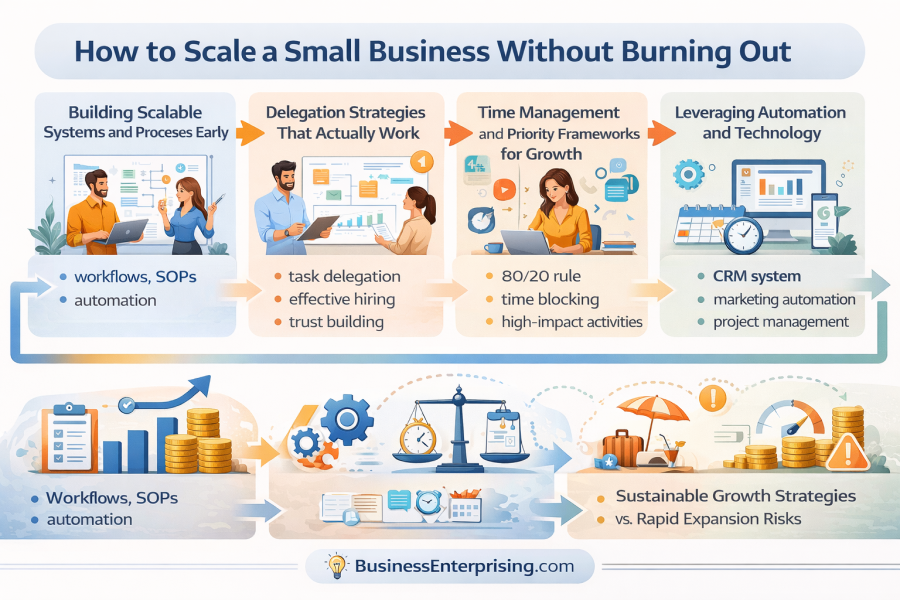
Leveraging Automation and Technology to Reduce Workload
Customer relationship management platforms like HubSpot CRM and Salesforce centralize customer data and automate follow ups. This reduces manual work while improving customer experience. Marketing automation tools such as ActiveCampaign allow you to create email sequences, track engagement, and nurture leads without constant input. Automation ensures consistent communication even as your business grows.
Platforms like Asana and Trello help organize tasks, assign responsibilities, and track progress. This creates clarity across your team and reduces miscommunication.
Maintaining Work-Life Balance While Scaling
Growth can blur the line between work and personal life. Define working hours and stick to them. Avoid constant availability, which often leads to burnout. Downtime is not optional. Regular breaks and time away from the business improve decision making and long term performance. Many successful founders schedule personal time with the same discipline as meetings. Being constantly connected creates stress and reduces focus. Turn off notifications during deep work sessions and limit after-hours communication. This improves both productivity and well being.
Sustainable Growth Strategies vs. Rapid Expansion Risks
Scaling increases expenses before revenue catches up. Monitor cash flow closely and maintain reserves. Expanding too quickly without financial stability can create serious risk. Hiring too fast leads to inefficiencies, while hiring too late creates bottlenecks. Align hiring decisions with clear operational needs and revenue benchmarks.
Growth should match your ability to deliver quality. Overcommitting can damage your reputation and lead to customer dissatisfaction. Controlled scaling protects both your brand and your team.
FAQ
How do you scale a small business without hiring too many employees?
You can scale by improving systems, automating processes, and outsourcing specialized tasks. This reduces the need for a large internal team.
What is the biggest mistake when scaling a business?
The most common mistake is trying to grow without systems in place. This leads to chaos, inefficiencies, and burnout.
How do you know when your business is ready to scale?
You are ready when you have consistent revenue, repeatable processes, and clear demand for your product or service.
Can automation replace employees when scaling?
Automation can handle repetitive tasks, but human oversight is still needed for strategy, relationships, and decision making.
Scaling a business does not have to come at the cost of your time or health. When you build systems, delegate effectively, and focus on high impact activities, growth becomes manageable and sustainable. The businesses that succeed long term are not the ones working the hardest, but the ones operating the smartest.