

 Choosing the right business structure shapes how your company grows and operates. Many entrepreneurs compare LLC vs. Corporation when deciding how to form a new venture. This decision affects taxes, liability, and how you manage daily operations. Therefore, you need a clear understanding before moving forward.
First, you should know that each structure offers different benefits. While both provide liability protection, they differ in management and taxation. As a result, your choice will impact your long term strategy. Moreover, investors, partners, and lenders often view these structures differently.
Next, you must consider how much control you want over operations. An LLC allows flexible management, which suits many small business owners. Meanwhile, corporations follow a formal structure with defined roles and processes. Because of this, your leadership style matters when making a decision.
In addition, taxes play a major role in your selection. LLCs often allow profits to pass directly to owners, which simplifies reporting. On the other hand, corporations may face different tax rules depending on their classification. Consequently, your financial goals should guide your choice.
Furthermore, you should evaluate your growth plans. If you plan to raise capital or expand quickly, your structure can influence those opportunities. Likewise, compliance requirements and costs will affect your operations over time.
Ultimately, you want a structure that aligns with your vision and resources. By understanding the differences, you can make a confident decision. As you move forward, each factor will help you build a strong foundation for success.
KEY DIFFERENCES BETWEEN AN LLC AND A CORPORATION
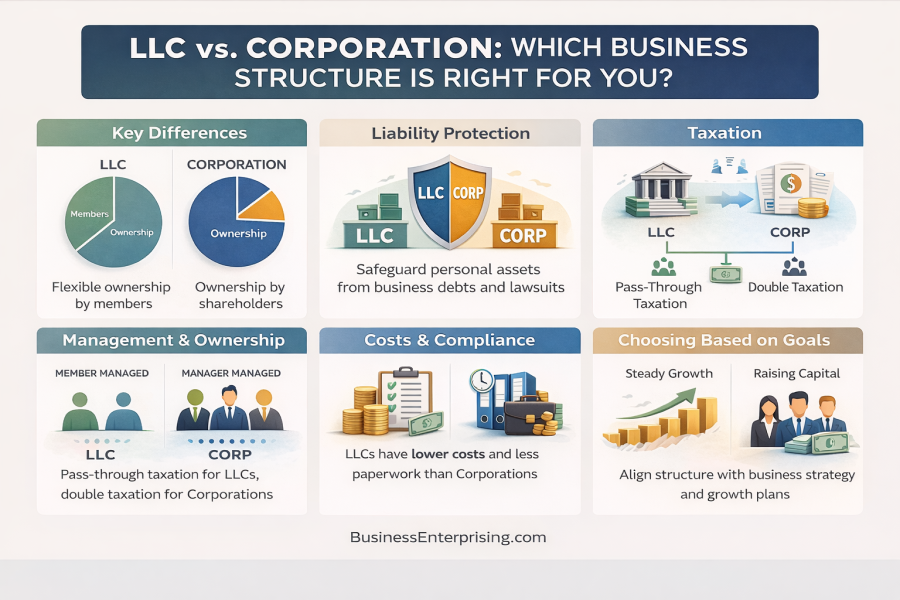
When comparing LLC vs. Corporation, you should first understand their foundational differences. An LLC is a flexible entity owned by members. Meanwhile, a corporation is a separate legal entity owned by shareholders. Because of this, ownership structures differ significantly.
First, LLCs offer a simple formation process in most states. You typically file articles of organization and create an operating agreement. In contrast, corporations require articles of incorporation and bylaws. As a result, corporations follow stricter formation procedures.
Next, legal identity plays an important role in how each structure operates. Both entities exist separately from their owners. However, corporations maintain a more formal separation through structured governance. Therefore, corporations often appear more established to outside parties.
In addition, operational flexibility sets these structures apart. LLCs allow you to manage your business without rigid rules. You can choose member managed or manager managed structures. On the other hand, corporations must follow a defined hierarchy with directors and officers.
Moreover, decision making processes differ between the two. LLCs allow owners to set their own rules for voting and control. Meanwhile, corporations rely on board decisions and shareholder input. Because of this, corporations may involve more layers of approval.
Furthermore, recordkeeping requirements also vary. LLCs often maintain fewer formal records. Corporations must document meetings, resolutions, and decisions regularly. As a result, corporations demand more administrative effort.
Ultimately, you should choose based on how you prefer to operate. If flexibility matters most, an LLC may suit you better. If structure and formal governance appeal to you, a corporation may align with your goals.
LIABILITY PROTECTION AND LEGAL SEPARATION
When evaluating LLC vs. Corporation, liability protection is often a top concern. Both structures separate your personal assets from business obligations. Therefore, your personal finances remain protected in most situations.
First, LLCs protect members from business debts and legal claims. This means creditors usually cannot pursue your personal assets. Similarly, corporations shield shareholders from liability tied to company activities. Because of this, both structures provide a strong layer of protection.
However, legal separation depends on how you operate your business. You must keep personal and business finances separate. In addition, you should follow all required formalities. Otherwise, courts may disregard the entity’s protection.
Next, the concept of piercing the corporate veil applies to both structures. This occurs when a court holds owners personally liable. For example, commingling funds or failing to maintain records can trigger this outcome. As a result, proper management becomes essential.
Moreover, corporations often maintain stricter formalities than LLCs. They require regular meetings, documented decisions, and clear governance. While LLCs offer flexibility, you still need to act responsibly. Therefore, consistent documentation strengthens your protection.
In addition, contracts and agreements play a key role in maintaining separation. You should always sign documents in your business name. This reinforces the distinction between you and your company. Consequently, your liability shield remains intact.
Ultimately, both structures can protect your personal assets when managed properly. Your responsibility is to follow best practices and maintain separation. By doing so, you preserve the legal benefits each structure provides.
TAXATION: PASS THROUGH VS CORPORATE TAX STRUCTURES
When analyzing LLC vs. Corporation, taxation often drives your final decision. Each structure offers different ways to handle income and reporting. Therefore, you should understand how each approach affects your finances.
First, LLCs typically use pass through taxation. This means profits and losses pass directly to members. You report this income on your personal tax return. As a result, you avoid a separate business level tax in most cases.
Next, corporations follow a different tax model. Traditional corporations pay taxes on their profits at the corporate level. Then, shareholders may pay taxes on dividends. Because of this, some businesses experience double taxation.
However, corporations can elect S corporation status under certain conditions. This allows income to pass through to shareholders, similar to an LLC. Therefore, you gain more flexibility in how you structure your taxes.
In addition, LLCs offer options for tax classification. You can choose to be taxed as a sole proprietorship, partnership, or corporation. This flexibility allows you to align taxes with your financial strategy. Consequently, you can adjust your approach as your business grows.
Moreover, tax planning becomes important as your revenue increases. You should consider how profits, distributions, and reinvestment affect your obligations. Working with a tax professional can help you optimize your structure over time. Ultimately, your choice depends on your income goals and financial plans. Both structures offer advantages depending on your situation. By understanding these tax differences, you can make a more informed decision.
MANAGEMENT STRUCTURE AND OWNERSHIP REQUIREMENTS
When reviewing LLC vs. Corporation, management structure plays a major role in your experience. Each option defines how decisions are made and who holds authority. Therefore, you should choose based on how you prefer to operate.
First, LLCs offer flexible management options. You can manage the business yourself or appoint a manager. This allows you to tailor operations to your needs. As a result, many small business owners prefer this approach.
Next, corporations follow a formal management structure. Shareholders own the company, while directors oversee major decisions. Officers handle daily operations. Because of this, corporations create a clear chain of command.
In addition, ownership requirements differ between the two structures. LLCs have fewer restrictions on ownership. Individuals, companies, and even foreign entities can own shares. Meanwhile, certain corporations must meet specific ownership rules.
Moreover, corporations often appeal to investors due to their structure. The ability to issue shares makes raising capital easier. Therefore, businesses seeking funding may favor this model.
Furthermore, LLCs provide flexibility in profit distribution. You can allocate profits based on your agreement, not ownership percentage. This allows creative financial arrangements among members. Consequently, LLCs support a wide range of business models.
In contrast, corporations distribute profits through dividends based on share ownership. This creates a standardized approach to payouts. While structured, it may limit flexibility in certain situations.
Ultimately, your decision depends on your leadership style and growth plans. If you value flexibility, an LLC may fit your needs. If you prefer structure and scalability, a corporation may be a better match.
COSTS, COMPLIANCE, AND ADMINISTRATIVE REQUIREMENTS
When comparing LLC vs. Corporation, costs and compliance requirements can influence your decision. Both structures involve startup expenses and ongoing obligations. Therefore, you should evaluate these factors carefully.
First, forming an LLC often costs less than forming a corporation. Filing fees and paperwork are usually simpler. As a result, many entrepreneurs choose LLCs for their affordability.
Next, corporations typically involve higher formation costs. You must file additional documents and establish formal governance. Because of this, initial expenses may be higher compared to LLCs.
In addition, ongoing compliance differs between the two structures. LLCs generally require fewer formalities. You may need to file annual reports and maintain basic records. Meanwhile, corporations must hold regular meetings and document decisions.
Moreover, recordkeeping requirements play a significant role. Corporations must maintain detailed minutes and corporate records. This adds to administrative workload over time. Therefore, you should consider how much structure you can manage.
Furthermore, regulatory requirements vary by state. Both entities must comply with local laws and filing deadlines. Missing these requirements can result in penalties or loss of good standing.
In contrast, LLCs offer a more relaxed administrative approach. This allows you to focus on operations rather than paperwork. However, you still need to maintain accurate records and filings.
Ultimately, your choice should reflect your resources and tolerance for administrative tasks. If you prefer simplicity, an LLC may be more suitable. If you can manage formal processes, a corporation may work well.
CHOOSING THE RIGHT STRUCTURE BASED ON YOUR BUSINESS GOALS
When deciding between LLC vs. Corporation, your business goals should guide your choice. Each structure supports different strategies and growth plans. Therefore, you need to align your decision with your long term vision.
First, consider how you plan to grow your business. If you aim for steady growth with limited outside investment, an LLC may suit you. This structure allows flexibility and simpler management. As a result, you can adapt quickly to changes.
Next, think about your funding needs. Corporations often attract investors more easily due to their structure. The ability to issue shares supports large scale funding efforts. Therefore, startups seeking capital may prefer corporations.
In addition, evaluate your ownership preferences. LLCs allow customized ownership arrangements and profit sharing. This works well for partnerships or family businesses. Meanwhile, corporations follow a standardized ownership model.
Moreover, consider your long term scalability. Corporations often support expansion into larger markets. Their structure can handle complex operations and multiple stakeholders. Consequently, they suit businesses planning significant growth.
Furthermore, assess your tolerance for administrative work. LLCs offer a simpler approach with fewer formal requirements. Corporations require ongoing documentation and governance. Therefore, your time and resources should factor into your decision.
Finally, think about your exit strategy. Selling shares in a corporation can be more straightforward. LLC ownership transfers may require more coordination. As a result, your future plans should influence your structure choice.
Ultimately, the right structure supports your goals and operations. By aligning your decision with your vision, you set your business up for long term success.

Q&A
| Question | Answer |
|---|---|
| What is the main difference between an LLC and a corporation? | The main difference lies in structure and flexibility. An LLC offers simpler management and flexible operations, while a corporation follows a formal hierarchy with shareholders and directors. This distinction impacts decision making, governance, and how your business grows over time. |
| How does liability protection work in both structures? | Both structures separate personal and business assets, which helps protect you from business debts and lawsuits. However, you must maintain proper records and avoid mixing finances. Failure to follow these practices can weaken your liability protection and expose personal assets. |
| Which structure is better for taxes? | Tax advantages depend on your financial goals. LLCs typically use pass through taxation, which simplifies reporting. Corporations may face double taxation, though S corporation elections can change this. Choosing between LLC vs. Corporation often depends on income levels and long term strategy. |
| Is it easier to manage an LLC or a corporation? | An LLC is generally easier to manage because it has fewer formal requirements. You can structure management based on your preferences. Corporations require formal roles, meetings, and documentation, which can increase administrative work and complexity. |
| Which structure is better for raising investment? | Corporations tend to attract investors more easily because they can issue shares. This structure supports venture capital and large funding rounds. LLCs can still raise funds, but their structure may limit certain investment opportunities compared to corporations. |