
 Buying a business can feel straightforward when numbers look strong. However, appearances often hide deeper issues. Therefore, you need a disciplined approach from the start. Additionally, understanding acquisition red flags early helps you avoid costly mistakes. As a result, you make decisions based on clarity rather than momentum.
Additionally, acquisitions combine financial, legal, and operational elements. Therefore, small gaps can grow into major problems after closing. Also, optimism can cloud judgment during negotiations. Consequently, you benefit from slowing down and asking harder questions.
Moreover, sellers often present the business at its best. Therefore, you should test claims against facts. Additionally, consistency across records matters more than polished explanations. As a result, careful review reveals how the business truly operates.
Meanwhile, due diligence serves as more than a checklist. Therefore, it becomes your primary risk management tool. Additionally, the process helps you understand how value actually gets created. Consequently, you gain insight into sustainability and future performance.
Furthermore, many buyers focus heavily on growth potential. Therefore, they may overlook structural weaknesses. Additionally, weak foundations limit long term success. As a result, growth plans can fail despite strong demand.
Additionally, acquisitions affect your time, focus, and capital. Therefore, alignment with your goals matters. Also, surprises after closing drain energy quickly. Consequently, preparation protects more than your balance sheet.
Accordingly, the smartest buyers approach acquisitions with healthy skepticism. Therefore, you should verify before trusting. Additionally, clear documentation and consistent answers signal discipline. As a result, confidence grows through evidence, not persuasion.
Ultimately, buying a business rewards patience and structure. Therefore, you benefit from treating diligence as an investment. Additionally, thoughtful analysis supports better outcomes. Consequently, you position yourself for stability, control, and sustainable growth.
Inconsistent or Unverifiable Financial Statements
Inconsistent or unverifiable financial statements often signal problems that reach beyond simple bookkeeping mistakes. Therefore, when you compare revenue reports, tax filings, and bank statements, numbers should align closely. Additionally, repeated gaps suggest reporting habits that lack discipline. As a result, you may struggle to trust any performance claims presented during negotiations.
Additionally, mismatches between reported revenue and tax returns raise concerns about accuracy and intent. Therefore, if a seller reports strong sales but files modest taxable income, you should pause. Also, bank deposits should reflect actual operating activity. Consequently, unexplained differences may indicate cash handling issues or selective reporting.
Moreover, these discrepancies frequently reflect deeper operational weaknesses. Therefore, poor financial controls often accompany weak management practices. Additionally, businesses with sloppy records tend to rely on memory rather than systems. As a result, you inherit confusion instead of clarity after closing.
Meanwhile, unverifiable statements also complicate financing and valuation discussions. Therefore, lenders and investors may discount your deal assumptions. Additionally, you could face delays while attempting to reconcile records. Consequently, momentum slows and confidence erodes across the transaction process.
Accordingly, you should treat inconsistent financials as early acquisition red flags rather than minor cleanup tasks. Additionally, you gain leverage by requesting reconciliations before advancing talks. Therefore, clear records protect your capital and your timeline. As a result, disciplined review supports better decisions and smoother ownership transitions.
Overdependence on a Single Customer, Vendor, or Key Employee
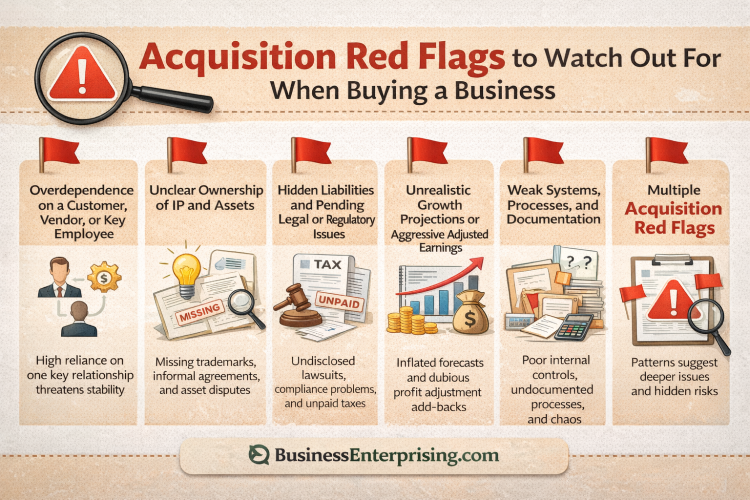
Overdependence on a single customer, vendor, or key employee creates real exposure during an acquisition. Therefore, you should examine revenue concentration early. Additionally, reliance on one relationship limits flexibility. As a result, stability after closing becomes harder to predict.
Additionally, when one customer drives most revenue, your risk rises immediately. Therefore, a contract loss or pricing dispute can disrupt cash flow. Consequently, you inherit volatility that you cannot easily control. Also, customer concentration weakens your negotiating position after purchase.
Similarly, dependence on a single vendor creates operational pressure. Therefore, supply interruptions or price increases can affect margins quickly. Additionally, informal vendor relationships often lack enforceable terms. As a result, your operations may stall without warning.
Moreover, reliance on one key employee raises serious continuity concerns. Therefore, knowledge concentrated in one person limits scalability. Additionally, employee departures often follow ownership changes. Consequently, you may face disruption before you can implement improvements.
Meanwhile, sellers may downplay concentration risk during discussions. Therefore, you should review contracts, customer histories, and employee roles carefully. Additionally, you should assess how relationships transfer after closing. As a result, you avoid surprises that affect performance.
Accordingly, concentration issues often appear among common acquisition red flags. Therefore, you should factor this risk into valuation and deal structure. Additionally, diversification plans should begin before closing. As a result, you protect your investment and support smoother transitions.
Ultimately, healthy businesses spread risk across customers, suppliers, and people. Therefore, you benefit from stability and optionality. Additionally, balanced relationships give you room to grow on your terms. Consequently, disciplined review helps you move forward with confidence.
Unclear Ownership of Intellectual Property and Assets
Unclear ownership of intellectual property and assets introduces risk that often surfaces after closing. Therefore, you should confirm who legally owns what. Additionally, missing documentation weakens your position. As a result, value you expect may not transfer with the business.
Additionally, trademarks frequently cause confusion during acquisitions. Therefore, you should verify registrations match the selling entity. Also, sellers sometimes operate under names they do not own. Consequently, you may face disputes once ownership changes.
Similarly, informal licensing agreements create exposure. Therefore, verbal permissions or handshake deals offer little protection. Additionally, licensors may refuse to continue terms under new ownership. As a result, you could lose access to software, branding, or content that supports revenue.
Moreover, asset ownership often differs from operational use. Therefore, equipment, domains, or data may belong to another party. Additionally, related entities sometimes hold key assets outside the sale. Consequently, your purchase may exclude items you assumed were included.
Meanwhile, unclear ownership complicates financing and integration. Therefore, lenders may question collateral value. Additionally, your legal team may need extra time to resolve gaps. As a result, timelines stretch and costs rise.
Accordingly, these issues rank among common acquisition red flags during diligence. Therefore, you should request proof of ownership for all assets. Additionally, you should review assignments and transfer rights before closing. As a result, you reduce post closing disputes.
Ultimately, clean ownership structures support smoother transitions. Therefore, you gain confidence in what you buy. Additionally, clarity protects your ability to operate and grow. Consequently, disciplined review helps you avoid problems that surface too late.
Hidden Liabilities and Pending Legal or Regulatory Issues
Hidden liabilities and pending legal or regulatory issues often surface after excitement fades. Therefore, you should approach diligence with caution. Additionally, many obligations remain invisible during early reviews. As a result, surprises may emerge once you assume control.
Additionally, unresolved lawsuits can follow the business into your ownership. Therefore, you should ask about threatened claims, not only active cases. Also, settlements in progress may affect cash flow. Consequently, legal exposure can change your financial outlook quickly.
Similarly, compliance violations create ongoing risk. Therefore, you should review regulatory history carefully. Additionally, unresolved notices or audits may trigger penalties later. As a result, your operating costs may rise unexpectedly.
Moreover, unpaid taxes often hide behind optimistic financial summaries. Therefore, you should reconcile filings with payment records. Additionally, payroll and sales taxes deserve special attention. Consequently, tax authorities may pursue collection after closing.
Meanwhile, contractual obligations can limit flexibility post acquisition. Therefore, long term leases, vendor contracts, or guarantees matter. Additionally, some agreements restrict assignment to new owners. As a result, you may inherit commitments you cannot easily change.
Accordingly, these issues often rank among serious acquisition red flags. Therefore, you should request full disclosure schedules early. Additionally, representations and warranties deserve careful review. As a result, you protect yourself against known and unknown exposure.
Furthermore, hidden liabilities affect valuation and deal structure. Therefore, you may need price adjustments or escrow arrangements. Additionally, extended diligence timelines may make sense. Consequently, patience can reduce long term risk.
Ultimately, thorough review supports better decisions. Therefore, you gain clarity about what you assume. Additionally, informed buyers avoid costly corrections later. Consequently, careful diligence helps you move forward with confidence.
Unrealistic Growth Projections or Aggressive Adjusted Earnings
Unrealistic growth projections and aggressive adjusted earnings often distort how a business truly performs. Therefore, you should compare forecasts against historical results. Additionally, sharp growth claims deserve careful scrutiny. As a result, you avoid relying on optimism instead of evidence.
Additionally, inflated projections often rest on assumptions that lack support. Therefore, you should ask how management plans to achieve rapid expansion. Also, projections should reflect past capacity and market conditions. Consequently, gaps between history and forecasts signal risk.
Similarly, excessive add backs can misrepresent operating earnings. Therefore, you should review each adjustment closely. Additionally, recurring expenses should not appear as one time items. As a result, adjusted numbers may overstate sustainable profit.
Moreover, sellers sometimes label normal costs as temporary. Therefore, marketing, staffing, or owner compensation may appear excluded. Additionally, these costs often continue after closing. Consequently, your cash flow may fall short of expectations.
Meanwhile, aggressive assumptions often ignore operational constraints. Therefore, staffing limits, supply issues, or customer churn matter. Additionally, growth requires capital and execution capacity. As a result, unrealistic assumptions weaken deal quality.
Accordingly, these patterns rank among common acquisition red flags during financial review. Therefore, you should ground valuation in verified performance. Additionally, sensitivity analysis helps test downside scenarios. As a result, you gain a clearer view of risk.
Furthermore, lenders and investors question inflated projections quickly. Therefore, weak assumptions can slow financing approvals. Additionally, credibility matters throughout negotiations. Consequently, disciplined analysis strengthens your position.
Ultimately, sustainable growth follows demonstrated trends. Therefore, you benefit from conservative modeling. Additionally, realistic earnings support better planning after closing. Consequently, careful review protects your capital and expectations.
Weak Systems, Processes, and Documentation
Weak systems, processes, and documentation often signal problems that surface after closing. Therefore, you should look beyond surface performance. Additionally, operational gaps can hide behind strong revenue. As a result, integration becomes harder than expected.
Additionally, poor internal controls create confusion around decision making. Therefore, approvals, reporting, and accountability may feel inconsistent. Also, teams may rely on habit instead of process. Consequently, errors increase as the business grows.
Similarly, undocumented procedures slow progress quickly. Therefore, employees depend on tribal knowledge. Additionally, training new staff becomes inefficient. As a result, productivity suffers during ownership transitions.
Moreover, operational chaos often strains management attention. Therefore, leaders spend time fixing avoidable issues. Additionally, fires replace planning. Consequently, growth initiatives stall before they begin.
Meanwhile, weak systems complicate post acquisition integration. Therefore, aligning technology, reporting, and workflows takes longer. Additionally, parallel processes may persist across teams. As a result, costs rise while clarity declines.
Additionally, scalability depends on repeatable processes. Therefore, businesses without documentation struggle to expand. Also, inconsistent execution damages customer experience. Consequently, revenue growth may flatten despite demand.
Accordingly, these conditions appear frequently among acquisition red flags. Therefore, you should assess systems during diligence. Additionally, you should ask how work gets done daily. As a result, you gain insight into true operating health.
Furthermore, lenders and partners value operational discipline. Therefore, weak controls may affect financing terms. Additionally, confidence drops when answers vary by employee. Consequently, credibility suffers during negotiations.
Ultimately, strong operations rely on structure and clarity. Therefore, you benefit from documented processes and controls. Additionally, order supports smoother transitions after closing. Consequently, thoughtful review protects your investment and timeline.
Conclusion
Buying a business involves more than trusting surface level performance. Therefore, you need discipline and patience throughout the process. Additionally, careful review helps you separate opportunity from risk. As a result, you protect your capital and expectations.
Additionally, red flags rarely appear in isolation. Therefore, small issues often connect to larger problems. Also, patterns matter more than single data points. Consequently, you benefit from stepping back and assessing the full picture.
Moreover, effective diligence requires asking direct questions. Therefore, you should challenge assumptions early. Additionally, clear answers build confidence on both sides. As a result, productive discussions replace uncertainty.
Meanwhile, you should view diligence as a decision tool, not a formality. Therefore, each finding should inform price, structure, or timing. Additionally, unresolved issues deserve real weight. Consequently, you avoid emotional decisions driven by momentum.
Furthermore, walking away remains a valid outcome. Therefore, discipline protects you from long term regret. Additionally, time invested upfront saves greater costs later. As a result, patience often delivers better outcomes.
Accordingly, acquisition red flags serve as signals, not obstacles. Therefore, they guide smarter negotiation and planning. Additionally, they highlight where added support or protection may be needed. As a result, you gain leverage through preparation.
Additionally, strong buyers focus on clarity over speed. Therefore, clean records and aligned expectations matter. Also, transparent sellers tend to support smoother transitions. Consequently, trust grows when diligence feels balanced.
Ultimately, successful acquisitions rest on informed judgment. Therefore, you should value consistency, transparency, and structure. Additionally, thoughtful review supports confident ownership changes. Consequently, you position yourself for stability and growth after closing.