 Artificial intelligence now plays a visible role in many industries. Companies use AI to analyze data, automate tasks, and speed operations. Therefore, many professionals wonder how technology will influence future careers. Because of these qualities, several industries represent businesses AI can’t replace. Technology can support efficiency, research, and planning. Yet human insight continues guiding important decisions
However, automation does not replace every type of work. Many professions rely on human judgment, creativity, and personal connection. Consequently, certain roles continue depending on skills that technology cannot fully imitate.
For example, leaders often evaluate decisions that involve ethics, timing, and human impact. You consider context and long term outcomes together. As a result, experience still shapes many strategic choices.
Similarly, professionals who build relationships depend on trust and credibility. Clients and partners often prefer working with someone they understand. Therefore, personal communication remains central to many industries.
Moreover, creative fields demonstrate how imagination drives innovation and brand development. You interpret cultural trends and express ideas that resonate with people. Consequently, original thinking continues guiding creative industries.
Likewise, many technical professions require hands on skill and practical reasoning. Electricians, mechanics, and contractors solve problems in unpredictable environments. Therefore, real world experience plays a large role in their work.
Meanwhile, care based professions rely on empathy and emotional awareness. Healthcare providers, therapists, and educators listen carefully and respond thoughtfully. As a result, human understanding remains central to meaningful support..
Furthermore, entrepreneurs demonstrate how opportunity creation begins with observation and curiosity. You recognize emerging needs and imagine new solutions. Therefore, innovation still grows from human initiative.
Ultimately, artificial intelligence will remain an important tool for many organizations. However, your creativity, judgment, and empathy continue shaping how businesses evolve.
Human Judgment and Strategic Decision Making
Human judgment plays a central role in strategic decision making. Leaders evaluate risk, timing, and long term impact. AI tools process data quickly. However, they cannot understand business context the way experienced professionals do.
For example, you often weigh market conditions, client behavior, and competitive signals before choosing a strategy. Therefore, your decisions combine analysis with experience. AI can highlight patterns, yet it cannot fully interpret human behavior.
Additionally, executive leaders frequently face ethical decisions that algorithms cannot resolve. You must consider reputation, trust, and long term relationships. Consequently, leadership requires responsibility that software cannot assume.
Similarly, strategic consultants guide companies through uncertainty and growth planning. They analyze information, yet they also interpret market dynamics. However, interpretation requires perspective shaped by real experience.
Moreover, business leaders consider timing when making high level decisions. A strategy that works this quarter may fail next year. Therefore, you must evaluate trends, economic signals, and organizational readiness together.
Likewise, negotiation and partnership decisions rely heavily on judgment. You read subtle signals during conversations and negotiations. Meanwhile, AI systems cannot fully interpret tone, intention, or unspoken concerns.
Because of this, leadership remains one of the clearest examples of businesses AI can’t replace. You bring accountability to every decision you make. Additionally, you carry responsibility for outcomes that affect employees, clients, and investors.
Furthermore, strategic thinking requires imagination about possible futures. You envision scenarios, test ideas, and choose a direction. Consequently, business leadership blends analysis, experience, and intuition.
Ultimately, organizations rely on people to make complex decisions. Data informs your thinking, yet judgment guides the final call. Therefore, experienced leaders remain essential to business strategy and long term success.
Relationship-Driven Professions That Depend on Trust
Many professions rely on strong personal relationships. Business often moves forward because people trust one another. Therefore, credibility and rapport shape many professional opportunities.
For example, business consultants build long term advisory relationships with clients. You listen carefully, understand concerns, and recommend thoughtful solutions. Consequently, clients rely on your judgment and integrity.
Similarly, sales professionals depend heavily on personal connection. Buyers rarely commit to large purchases without confidence in the person advising them. Therefore, trust influences decisions long before a contract appears.
Moreover, partnerships develop through repeated conversations and shared experience. You build confidence over time through honesty and follow through. As a result, strong professional relationships often grow from consistent communication.
However, AI systems cannot build genuine trust with another person. Technology can analyze data and organize information. Still, people form confidence through human interaction and real conversation.
Additionally, client advisory roles often involve sensitive business discussions. You may review financial concerns, market challenges, or operational problems. Therefore, clients prefer someone who listens and responds thoughtfully.
Meanwhile, negotiation requires awareness of tone, emotion, and intent. You read subtle signals during meetings and conversations. Consequently, emotional intelligence influences many successful agreements.
Furthermore, trusted advisors often guide clients during uncertain business moments. You help them evaluate options and discuss risks openly. As a result, your guidance becomes part of their decision process.
Because of this dynamic, relationship driven professions represent clear examples of businesses AI can’t replace. Software can support communication and research tasks. However, trust still develops through human presence and consistent interaction.
Likewise, strong professional relationships often lead to new opportunities. A satisfied client introduces you to colleagues or partners. Therefore, trust continues expanding through personal networks.
Creative Industries That Require Original Thought
Creative industries rely heavily on imagination and original thinking. Branding, advertising, and design all require ideas that connect with people. Therefore, creative professionals shape how audiences perceive companies and products.
For example, branding specialists translate a company’s identity into visual and verbal expression. You choose colors, language, and messaging that represent the brand. Consequently, creative judgment influences how customers recognize and remember businesses.
Similarly, advertising professionals develop ideas that capture attention and inspire action. You interpret audience behavior and craft concepts that resonate emotionally. As a result, successful campaigns often come from thoughtful creative direction.
Moreover, storytelling plays a powerful role in marketing and product development. You frame narratives that communicate purpose, value, and personality. Therefore, creative professionals guide how people experience a brand.
However, AI systems operate through pattern recognition and data training. They can generate images, headlines, or design options. Still, original creative direction usually begins with human thinking.
Likewise, product innovation often grows from curiosity and experimentation. You observe problems, imagine new solutions, and test unconventional ideas. Consequently, invention often reflects a creator’s perspective and curiosity.
Furthermore, design strategy requires interpretation of culture and consumer behavior. You recognize subtle shifts in taste, style, and expectations. Therefore, creative leaders translate those insights into meaningful design decisions.
Because of these qualities, creative fields represent strong examples of businesses AI can’t replace. Technology can support brainstorming and execution tasks. Yet human imagination still shapes the concepts that influence culture and markets.
Additionally, creative professionals often collaborate closely with clients and teams. You interpret goals, refine ideas, and guide projects toward a clear vision. As a result, creative leadership blends communication, insight, and artistic thinking.
Skilled Trades and Hands-On Technical Work
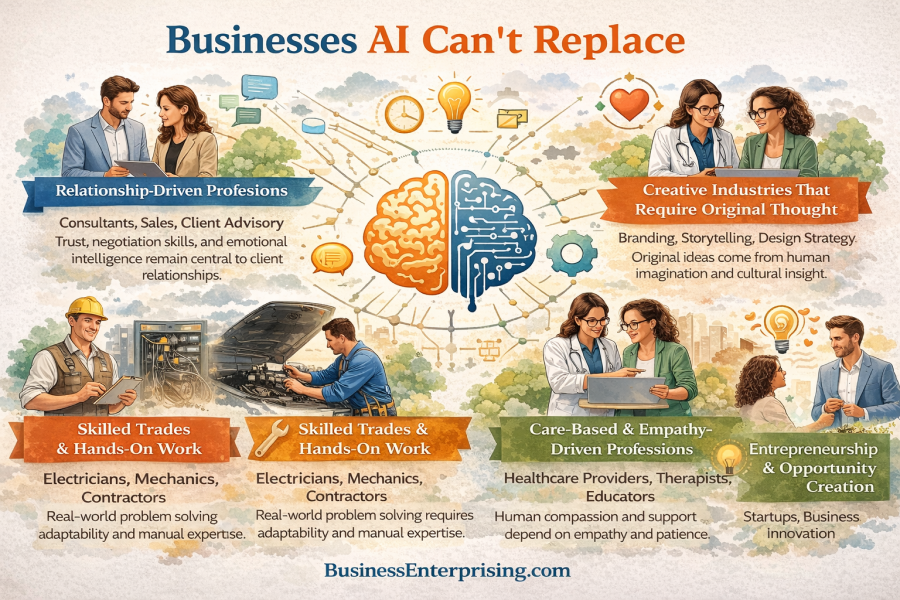
Many professions require hands on technical skill and practical problem solving. Electricians, mechanics, and contractors regularly handle situations that change quickly. Therefore, skilled trades continue relying heavily on human expertise.
For example, electricians diagnose wiring problems inside complex buildings. You must evaluate equipment, safety risks, and structural conditions simultaneously. Consequently, real world experience guides each repair decision.
Similarly, mechanics often face unexpected mechanical failures. You inspect parts, test systems, and interpret unusual sounds or vibrations. As a result, practical judgment becomes part of every repair process.
Moreover, contractors frequently coordinate work in active construction environments. You manage materials, timelines, and multiple specialists on site. Therefore, strong coordination and decision making help projects stay on schedule.
However, AI systems cannot easily function within unpredictable physical settings. Buildings, machinery, and equipment rarely present identical conditions. Still, experienced technicians adapt quickly through observation and hands on practice.
Likewise, skilled trades require manual dexterity and spatial awareness. You adjust tools, handle components, and work within confined spaces. Consequently, physical coordination plays a large role in technical work.
Furthermore, on site work often requires immediate decisions when problems appear. You evaluate safety, cost, and repair options within minutes. Therefore, practical reasoning guides many technical choices.
Because of these factors, skilled trades represent clear examples of businesses AI can’t replace. Software can assist with diagnostics and documentation. Yet human technicians still perform the work that restores systems and equipment.
Additionally, many trades involve direct communication with clients or property owners. You explain the issue, recommend solutions, and discuss repair options. As a result, trust grows through clear conversation and reliable work.
Ultimately, skilled trades combine physical skill with applied knowledge. Technology can support tools and diagnostics. However, human expertise continues driving repairs, installations, and technical service work.
Care-Based and Empathy-Driven Professions
Care based professions rely heavily on empathy and personal understanding. Healthcare providers, therapists, and educators interact with people during sensitive moments. Therefore, human connection remains central to these roles.
For example, healthcare professionals often guide patients through difficult medical decisions. You listen to concerns, answer questions, and provide reassurance. Consequently, patients value compassion alongside medical knowledge.
Similarly, therapists and counselors support individuals facing emotional stress. You observe tone, body language, and personal history during conversations. As a result, emotional awareness shapes every discussion.
Moreover, coaches and mentors help people develop confidence and direction. You encourage progress while addressing setbacks and uncertainty. Therefore, personal guidance plays a strong role in professional growth.
However, AI systems cannot genuinely understand human emotion. Technology can analyze patterns in language or behavior. Still, empathy develops through lived experience and emotional awareness.
Likewise, educators build trust with students over time. You recognize learning challenges, personal strengths, and motivational barriers. Consequently, effective teaching relies on patience and human communication.
Furthermore, care based professions often require sensitive judgment. You respond to complex emotional situations in real time. Therefore, thoughtful responses guide meaningful support.
Because of these qualities, care centered professions represent clear examples of businesses AI can’t replace. Technology may assist with scheduling, research, or documentation. Yet people continue seeking comfort and guidance from other people.
Additionally, meaningful support often grows from conversation and presence. You create a safe environment where others feel heard and understood. As a result, trust strengthens through genuine interaction.
Meanwhile, compassion also shapes long term relationships in healthcare and counseling. Patients and clients remember professionals who show patience and understanding. Therefore, empathy continues influencing professional success.
Ultimately, emotional support remains deeply human work. Data tools may assist professionals behind the scenes. However, authentic care still depends on empathy, listening, and human connection.
Entrepreneurship and Opportunity Creation
Entrepreneurship often begins with curiosity and observation. Entrepreneurs notice problems that others overlook. Therefore, new businesses frequently emerge from personal insight and initiative.
For example, you may recognize a gap in a product category or service market. You evaluate the opportunity and imagine a solution. Consequently, new ventures often begin with individual perspective and creativity.
Similarly, entrepreneurs regularly interpret cultural trends and shifting consumer behavior. You observe how people live, shop, and communicate. As a result, those observations guide new product ideas.
Moreover, launching a company requires risk tolerance and independent thinking. You commit resources, develop a plan, and move forward despite uncertainty. Therefore, entrepreneurship involves both vision and confidence.
However, AI systems operate primarily through data and past information. Technology can analyze trends and forecast outcomes. Still, recognizing new possibilities often comes from human curiosity.
Likewise, entrepreneurs build organizations by attracting talent and forming teams. You communicate goals, motivate people, and coordinate efforts. Consequently, leadership becomes part of the entrepreneurial process.
Furthermore, opportunity creation often requires experimentation and adaptation. You test ideas, adjust strategy, and refine business models. Therefore, innovation grows through repeated learning and decision making.
Because of these qualities, entrepreneurship represents one of the strongest examples of businesses AI can’t replace. Software can support planning and research. Yet human leaders still drive opportunity creation.
Additionally, entrepreneurs often inspire others through vision and persistence. You communicate possibilities that encourage employees, partners, and investors. As a result, people rally around clear leadership.
Meanwhile, building a business also requires personal accountability. You take responsibility for outcomes and future direction. Therefore, entrepreneurship blends creativity, leadership, and practical judgment.
Ultimately, new markets and companies grow from human ideas. Data tools may assist your planning and analysis. However, the decision to pursue an opportunity still begins with you.
Conclusion
Artificial intelligence continues expanding across many industries. Companies use AI tools for analysis, automation, and efficiency. Therefore, many routine tasks now move faster than before.
However, technology does not replace every type of work. Many roles still depend on judgment, creativity, and personal interaction. Consequently, people remain central to many business activities.
For example, leadership decisions often require experience and interpretation. You evaluate long term consequences and human factors together. As a result, business direction often depends on thoughtful leadership.
Similarly, relationship based professions continue relying on trust and credibility. Clients often prefer guidance from someone they know personally. Therefore, human communication remains central to advisory roles.
Moreover, creative professionals shape ideas that influence markets and culture. You interpret trends, develop concepts, and express original thinking. Consequently, brands still depend on human imagination.
Likewise, skilled trades demonstrate how practical expertise drives many industries. Electricians, mechanics, and technicians work within unpredictable environments. Therefore, physical skill and experience guide many technical solutions.
Meanwhile, care based professions show how empathy shapes meaningful support. Healthcare providers, therapists, and educators listen carefully to people. As a result, compassion continues influencing professional outcomes.
Because of these qualities, many professions represent businesses AI can’t replace. Technology can support planning, research, and efficiency improvements. Yet human judgment continues guiding complex decisions.
Furthermore, entrepreneurship demonstrates how opportunity creation begins with vision. You recognize unmet needs and pursue new ideas. Therefore, innovation often begins with personal initiative.
Additionally, organizations still rely on leadership and collaboration. You motivate teams, build partnerships, and guide strategy. Consequently, human leadership remains part of business progress.
Ultimately, artificial intelligence will remain an important business tool. However, your insight, creativity, and empathy continue shaping the future of work.