 Running a business often feels complex, yet knowing how to improve operations can simplify your path to growth. When your systems work well, your team performs better and your results become more predictable. So, you gain more control over daily activities and long term outcomes. At the same time, strong operations reduce wasted effort and help you focus on what drives revenue.
However, many businesses struggle with hidden inefficiencies that slow progress. For example, unclear processes and poor communication often create delays and confusion. As a result, your team may spend more time fixing issues than moving forward. Therefore, improving operations starts with understanding where problems exist.
Next, you need practical strategies that create measurable improvements. When you refine workflows and clarify responsibilities, your business runs more smoothly. In addition, better systems support faster decision making and stronger performance. So, you build a foundation that supports consistent growth.
At the same time, modern businesses must adapt quickly to changing demands. Because of this, operational flexibility plays a key role in staying competitive. When your processes allow for change, you can respond faster to new opportunities. As a result, your business stays relevant and efficient.
Ultimately, improving operations is not about working harder. Instead, it focuses on working smarter with the resources you already have. When you take a structured approach, you can create lasting improvements that support growth and profitability.
Identifying Operational Inefficiencies and Bottlenecks
To improve performance, you must first identify where your operations break down. When you understand weaknesses, you can take focused action that delivers real results. Therefore, learning how to improve operations begins with a clear diagnosis of your current systems.
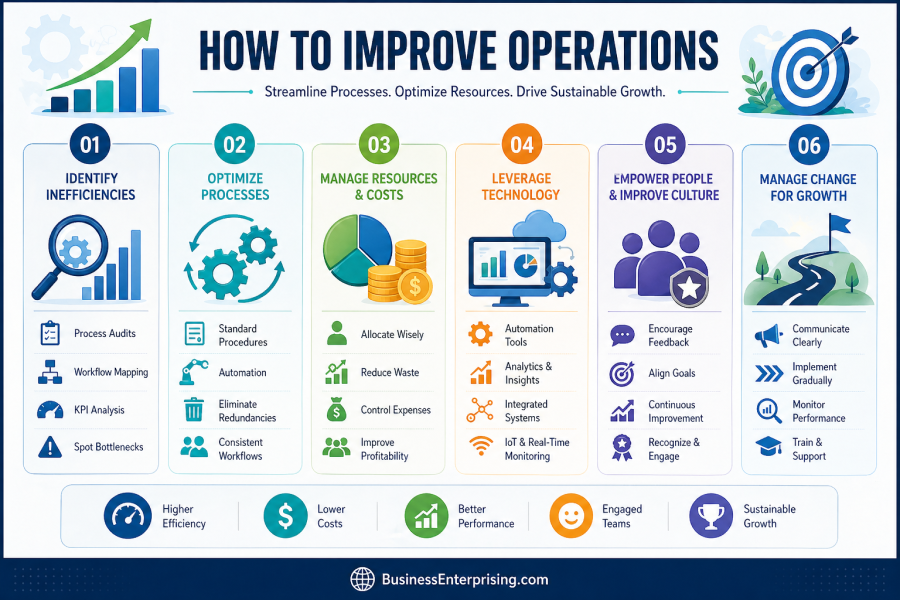
First, process audits help you evaluate how work moves through your business. By reviewing each step, you can spot delays, redundancies, and unnecessary tasks. As a result, you gain insight into areas that need attention.
Next, workflow mapping gives you a visual view of your operations. When you map processes, you can see how tasks connect and where breakdowns occur. So, you can quickly identify bottlenecks that slow progress.
In addition, key performance indicators provide measurable data about your operations. When you track metrics like turnaround time and productivity, you gain objective insights. Therefore, you can make decisions based on facts rather than assumptions.
At the same time, regular operational assessments keep your business aligned with your goals. When you evaluate performance consistently, you can address issues before they grow. As a result, your operations remain efficient and responsive.
Furthermore, structured training can help you build these skills effectively. The Business Operations Online Course teaches how to identify operational gaps and improve performance. Through guided frameworks, you can analyze your business with clarity and confidence.
Ultimately, identifying inefficiencies sets the foundation for meaningful improvement. When you understand your challenges, you can take targeted action that improves performance across your organization.
Process Optimization and Workflow Standardization
Once you identify inefficiencies, the next step is improving how work gets done. Clear processes reduce confusion and create consistency across your organization. Therefore, mastering how to improve operations requires strong process optimization.
First, standard operating procedures help define how tasks should be completed. When your team follows clear guidelines, work becomes more predictable and efficient. As a result, you reduce errors and improve overall performance.
Next, eliminating redundant steps can save time and resources. When you review workflows, you often find tasks that no longer add value. So, removing them allows your team to focus on meaningful work.
In addition, automation can streamline repetitive tasks. When you automate routine activities, your team gains more time for strategic work. Therefore, productivity increases without adding extra workload.
At the same time, consistent workflows improve collaboration across teams. When everyone follows the same processes, communication becomes clearer and faster. As a result, projects move forward without unnecessary delays.
Moreover, structured learning can support these improvements. The Business Operations Online Course provides guidance on optimizing systems and refining workflows. Through practical lessons, you can apply proven methods to your business. Ultimately, process optimization creates a stable foundation for growth. When your operations run smoothly, your business can scale without losing efficiency or quality.
Resource Management and Cost Optimization
Managing resources effectively plays a major role in operational success. When you allocate time, labor, and capital wisely, your business becomes more efficient. Therefore, understanding how to improve operations includes strong resource management.
First, analyzing how resources are currently used reveals opportunities for improvement. When you track spending and workload distribution, you can identify areas of waste. As a result, you gain better control over costs.
Next, prioritizing high value activities helps maximize output. When your team focuses on tasks that drive results, productivity increases. So, you get more value from the same resources.
In addition, reducing unnecessary expenses improves profitability. When you review budgets and eliminate waste, you can reinvest in growth initiatives. Therefore, your business becomes more financially stable.
At the same time, balancing workloads prevents burnout and improves performance. When your team has manageable responsibilities, they produce better results. As a result, efficiency and morale both improve.
Furthermore, structured training can support better decision making. The Business Operations Online Course teaches how to manage resources effectively. Through clear frameworks, you can optimize both cost and performance. Ultimately, effective resource management helps your business operate at its full potential. When you use your assets wisely, you create a stronger foundation for long term success.
Leveraging Technology to Improve Operational Efficiency
Technology plays a key role in modern operations. When used effectively, it can simplify processes and improve decision making. Therefore, learning how to improve operations includes integrating the right tools into your business.
First, automation software can handle repetitive tasks with speed and accuracy. When systems manage routine work, your team can focus on higher value activities. As a result, productivity increases across the organization.
Next, analytics platforms provide real time insights into performance. When you track data, you can identify trends and make informed decisions. So, your business becomes more responsive and efficient.
In addition, connected systems can improve communication between departments. When information flows easily, teams can collaborate more effectively. Therefore, projects move forward without unnecessary delays.
At the same time, technology supports better forecasting and planning. When you use data to guide decisions, you reduce uncertainty. As a result, your operations become more predictable and stable.
Moreover, structured education can help you apply these tools effectively. The Business Operations Online Course covers technology integration in operations. Through practical examples, you can implement solutions that improve efficiency. Ultimately, leveraging technology allows your business to operate smarter and faster. When systems support your team, you create a more efficient and scalable operation.
Building a Culture of Continuous Improvement and Employee Engagement
Strong operations depend on people as much as systems. When your team stays engaged, performance improves across the organization. Therefore, learning how to improve operations includes building a culture of continuous improvement.
First, encouraging feedback helps identify opportunities for growth. When employees share insights, you gain valuable perspectives on daily operations. As a result, you can address issues more effectively.
Next, aligning team goals with business objectives improves focus. When employees understand their role in success, they work with greater purpose. So, productivity and motivation both increase.
In addition, continuous improvement frameworks support ongoing progress. When you review processes regularly, you can make small changes that add up over time. Therefore, your operations evolve with your business needs.
At the same time, recognition and support improve employee satisfaction. When your team feels valued, they contribute more actively. As a result, engagement and performance both rise.
Furthermore, structured training can strengthen these efforts. The Business Operations Online Course provides tools for improving team performance and operational alignment. Through clear guidance, you can build a culture that supports growth. Ultimately, engaged employees drive better operational results. When your team takes ownership, your business becomes more efficient and adaptable.
Implementing Change Management for Sustainable Operational Growth
Improving operations requires change, and change must be managed carefully. When you introduce new processes effectively, your business can grow without disruption. Therefore, understanding how to improve operations includes strong change management practices.
First, clear communication helps your team understand upcoming changes. When employees know what to expect, they can adapt more easily. As a result, resistance decreases and adoption improves.
Next, phased implementation allows for smoother transitions. When you roll out changes gradually, you can address issues as they arise. So, your operations remain stable during the process.
In addition, monitoring performance helps track the impact of changes. When you measure results, you can refine your approach and improve outcomes. Therefore, your improvements become more effective over time.
At the same time, providing support and training helps employees adjust. When your team feels confident, they can adopt new systems more quickly. As a result, productivity remains strong during transitions.
Moreover, structured programs can guide this process. The Business Operations Online Course teaches change management strategies that support long term success. Through practical methods, you can implement improvements with confidence. Ultimately, effective change management supports sustainable growth. When you manage transitions well, your business can improve operations without disrupting performance.

KEY TAKEAWAYS
• You can improve operations by identifying inefficiencies through audits, workflows, and performance metrics.
• You should streamline processes with clear procedures and remove redundant steps to increase efficiency.
• You can manage resources better by reducing waste and focusing on high value activities.
• You should use technology to automate tasks and gain insights for better decision making.
• You can improve results by engaging your team and encouraging continuous improvement.
• You should manage change carefully to maintain stability while improving operations.
FAQ
| Question | Answer |
|---|---|
| What does it mean to improve operations in a business? | Improving operations means refining how your business functions daily. It includes streamlining processes, managing resources effectively, and reducing inefficiencies. When you improve operations, you create smoother workflows, better productivity, and stronger overall performance across your organization. |
| How can I identify inefficiencies in my operations? | You can identify inefficiencies by reviewing workflows, conducting audits, and tracking key performance indicators. These methods help you spot delays, unnecessary steps, and resource waste. When you analyze your operations regularly, you gain clear insights into where improvements are needed. |
| Why is process standardization important? | Process standardization creates consistency and clarity across your business. When your team follows defined procedures, tasks are completed more efficiently and with fewer errors. This approach also improves communication and helps your organization scale without losing quality or performance. |
| How does technology help improve operations? | Technology supports better operations by automating repetitive tasks and providing real time data. When you use the right tools, you can make faster decisions and improve workflow efficiency. This leads to stronger performance and a more responsive business environment. |
| What is the best way to start learning how to improve operations? | The best way to start is by gaining structured knowledge and applying it to your business. The Business Operations Online Course provides practical frameworks and tools that help you understand how to improve operations and implement changes effectively for long term success. |