 AI competitive advantage strategies are reshaping how you compete, grow, and deliver value across your business. Today, companies that act with clarity gain measurable advantages in speed, insight, and efficiency. As a result, you must understand where AI fits within your current operations. You cannot rely on assumptions or trends alone to guide your direction. Instead, you need a focused approach that aligns AI with your business goals.
Moreover, AI adoption is no longer limited to large enterprises with vast resources. Now, you can access tools that were once out of reach for smaller organizations. Because of this shift, competition has intensified across nearly every industry. Therefore, you must think strategically about how you apply AI within your organization. Random implementation often leads to wasted resources and missed opportunities.
At the same time, you should recognize that AI success depends on more than technology. It requires alignment between your data, processes, and people. Consequently, you need to approach AI as a business strategy, not a technical experiment. When you align these elements, you create systems that support long-term growth.
Furthermore, you must remain adaptable as AI continues to evolve. New tools and capabilities appear frequently, which can quickly change competitive dynamics. Because of this, your strategy should remain flexible and responsive. You should evaluate performance regularly and adjust your approach as needed.
Ultimately, your ability to gain an edge depends on how effectively you integrate AI into your core operations. When done well, AI can improve decisions, reduce costs, and open new revenue streams.
IDENTIFYING HIGH-IMPACT AREAS FOR AI IMPLEMENTATION
First, you need to identify where AI can deliver meaningful business impact. Not every function benefits equally from automation or intelligence. Therefore, you should evaluate your operations, marketing, and customer experience carefully. This step allows you to prioritize areas that drive measurable results.
Next, you should analyze repetitive processes that consume time and resources. These tasks often provide strong opportunities for AI integration. For example, you can automate data entry, customer inquiries, and reporting workflows. As a result, your team can focus on higher-value activities that require human insight.
Moreover, you should assess decision-making processes within your organization. Many businesses rely on manual analysis or outdated data. Because of this, decisions often lack speed and accuracy. By applying AI competitive advantage strategies, you can improve how you gather and interpret information. This shift allows you to make faster and more informed choices.
In addition, you should consider customer-facing applications. AI can personalize experiences, predict behavior, and improve engagement. When you understand customer needs more clearly, you strengthen relationships and increase retention. Consequently, your business becomes more responsive and competitive.
At the same time, you should evaluate financial and operational metrics. Areas with clear performance gaps often present strong AI opportunities. When you target these gaps, you can drive efficiency and reduce unnecessary costs.
Finally, you must align AI initiatives with your overall business goals. Technology alone does not create value without direction. Therefore, you should define clear objectives before implementing any solution. When you focus on high-impact areas, you maximize return on investment and accelerate growth.
LEVERAGING DATA AS A STRATEGIC ASSET
To begin, you must recognize that data drives every successful AI initiative. Without reliable data, AI systems cannot produce accurate insights. Therefore, you should evaluate the quality and consistency of your existing data. Clean, structured data allows your systems to perform effectively.
Next, you should focus on data ownership and accessibility. Many organizations store information across disconnected systems. As a result, teams struggle to access and use data efficiently. By centralizing your data, you improve visibility and collaboration across departments.
Moreover, you should integrate data sources to create a unified view of your business. When systems communicate effectively, you gain deeper insights into performance and behavior. This integration supports stronger decision-making and more accurate predictions. Within AI competitive advantage strategies, this step plays a central role.
In addition, you should establish clear data governance practices. These practices define how data is collected, stored, and used. When you maintain consistency, you reduce errors and improve reliability. Consequently, your AI systems produce more dependable outcomes.
At the same time, you should consider how data supports long-term growth. Historical data can reveal patterns that guide future strategies. When you analyze trends over time, you can identify opportunities and risks earlier. This foresight strengthens your competitive position.
Finally, you must invest in tools that support data management and analysis. Technology alone does not solve data challenges without proper structure. Therefore, you should align your tools with your business needs. When you treat data as a strategic asset, you create a strong foundation for AI success.
AI-DRIVEN DECISION MAKING AND PREDICTIVE ANALYTICS
First, you should understand how AI transforms decision-making processes. Traditional methods often rely on historical data and manual analysis. As a result, decisions can be slow and reactive. AI changes this dynamic by enabling predictive insights.
Next, you can use predictive analytics to anticipate trends and outcomes. These tools analyze patterns within large data sets. Because of this, you can forecast demand, identify risks, and plan more effectively. Within AI competitive advantage strategies, predictive capabilities offer significant value.
Moreover, you should apply AI to financial planning and risk management. Predictive models can identify potential issues before they occur. When you act early, you reduce losses and improve stability. This proactive approach strengthens your business performance.
In addition, you should integrate AI into marketing and sales strategies. Predictive insights can reveal customer behavior and preferences. As a result, you can tailor campaigns and improve conversion rates. This level of precision increases the effectiveness of your efforts.
At the same time, you should focus on improving operational efficiency. AI can identify bottlenecks and inefficiencies within your processes. When you address these issues, you reduce costs and improve output. Consequently, your operations become more streamlined.
Finally, you must train your team to interpret and use AI insights effectively. Technology alone does not guarantee better decisions. Therefore, you should build internal capabilities that support data-driven thinking. When you combine human judgment with AI insights, you create stronger outcomes.
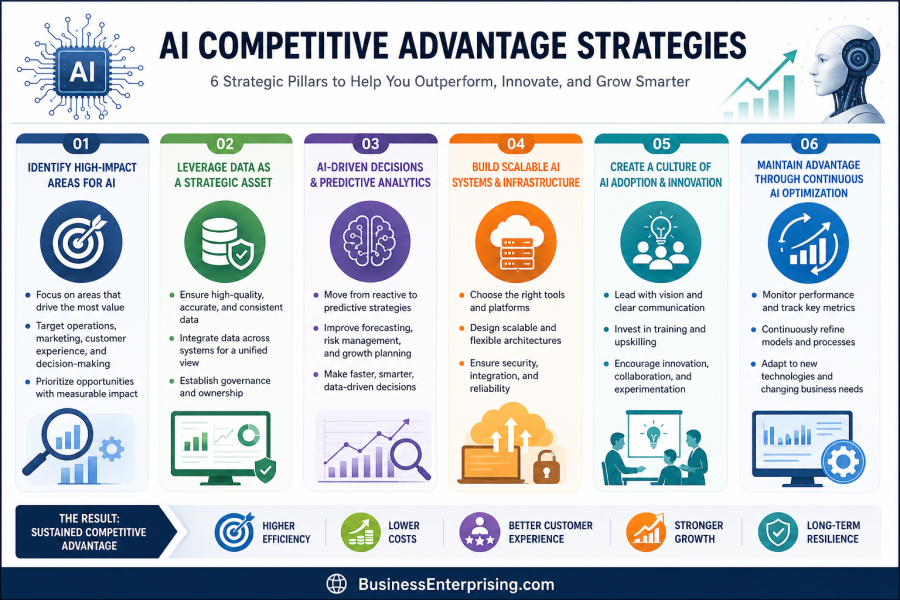
BUILDING SCALABLE AI SYSTEMS AND INFRASTRUCTURE
To begin, you must build systems that can grow with your business. Many organizations struggle because their infrastructure cannot support expansion. Therefore, you should select tools and platforms that allow flexibility and scalability.
Next, you should evaluate your current technology stack. Legacy systems often limit integration and performance. As a result, they can slow down AI adoption. By modernizing your infrastructure, you create a foundation for growth within AI competitive advantage strategies.
Moreover, you should prioritize cloud-based solutions. These platforms provide scalability, flexibility, and cost efficiency. When your systems can scale easily, you can adapt to changing demands. This capability supports long-term success.
In addition, you should design systems that allow seamless data flow. Integration between tools improves efficiency and accuracy. When systems communicate effectively, you reduce duplication and errors. Consequently, your operations become more efficient.
At the same time, you should focus on security and reliability. As your systems grow, risks also increase. Therefore, you must protect your data and maintain system performance. Strong security practices support trust and stability.
Finally, you should plan for continuous improvement. Technology evolves rapidly, and your systems must keep pace. When you invest in scalable infrastructure, you avoid costly rebuilds in the future. This approach allows you to expand your AI capabilities with confidence.
CREATING A CULTURE OF AI ADOPTION AND INNOVATION
First, you must recognize that people drive successful AI adoption. Technology alone cannot transform your organization. Therefore, you should focus on building a culture that supports innovation and learning.
Next, you should provide training and education for your team. Many employees feel uncertain about AI and its impact. As a result, they may resist change. By offering clear guidance, you build confidence and engagement.
Moreover, leadership plays a key role in shaping adoption. When leaders support AI initiatives, teams are more likely to follow. Within AI competitive advantage strategies, leadership alignment drives success. You must communicate the value and purpose of AI clearly.
In addition, you should encourage experimentation and creativity. Innovation often comes from testing new ideas. When you allow teams to explore, you uncover new opportunities. This approach fosters continuous improvement.
At the same time, you should address concerns about job security and change. Employees need reassurance and clarity about their roles. When you communicate openly, you build trust and reduce resistance.
Finally, you should align incentives with AI adoption. When employees see clear benefits, they are more likely to engage. This alignment supports long-term success and growth. By creating a strong culture, you maximize the impact of your AI initiatives.
MAINTAINING COMPETITIVE ADVANTAGE THROUGH CONTINUOUS AI OPTIMIZATION
To begin, you must recognize that AI is not a one-time investment. Systems require ongoing refinement to remain effective. Therefore, you should monitor performance regularly and make adjustments as needed.
Next, you should track key metrics that reflect business outcomes. These metrics help you evaluate the impact of your AI initiatives. Within AI competitive advantage strategies, continuous measurement supports improvement. When you track results, you can identify areas for enhancement.
Moreover, you should update models as new data becomes available. AI systems improve over time when they learn from fresh information. As a result, your insights become more accurate and relevant. This process strengthens your decision-making capabilities.
In addition, you should stay informed about new tools and advancements. Technology evolves quickly, and new opportunities appear often. By staying current, you can adopt solutions that improve performance.
At the same time, you should test and refine your processes. Small changes can lead to meaningful improvements. When you experiment and adapt, you maintain a strong competitive position.
Finally, you must align optimization efforts with your business goals. Technology should support strategy, not replace it. When you focus on continuous improvement, you sustain growth and remain competitive in a changing market.
KEY TAKEAWAYS
• You should focus AI efforts on areas that directly impact efficiency, revenue, or customer experience.
• You need strong, well-managed data to support reliable AI insights and long-term performance.
• You can improve decisions by using predictive analytics to anticipate trends and risks.
• You should build scalable systems that grow with your business and support future AI expansion.
• You must foster a culture that encourages learning, adoption, and innovation across your organization.
• You should continuously refine AI systems to maintain performance and stay ahead of competitors.

FAQ
| Question | Answer |
|---|---|
| What are AI competitive advantage strategies? | AI competitive advantage strategies refer to how you use artificial intelligence to outperform competitors. This includes improving decision-making, automating processes, and gaining insights from data. When applied effectively, these strategies help you increase efficiency, reduce costs, and create stronger customer experiences. |
| How do I identify where to implement AI in my business? | You should evaluate your operations, customer interactions, and decision-making processes. Look for repetitive tasks, inefficiencies, and areas with high data usage. These often present strong opportunities for AI integration that can deliver measurable improvements and support business growth. |
| Why is data important for AI success? | Data provides the foundation for all AI systems. When your data is clean, organized, and accessible, your AI tools can generate accurate insights. Poor data quality leads to unreliable results, which can impact decisions and reduce the effectiveness of your overall strategy. |
| How can AI improve decision-making? | AI analyzes large data sets to identify patterns and trends that humans may miss. This allows you to predict outcomes, manage risks, and plan more effectively. As a result, your decisions become faster, more informed, and aligned with real-time insights. |
| How do I maintain AI performance over time? | You should monitor system performance regularly and update models with new data. Continuous testing and refinement help improve accuracy and relevance. Staying informed about new technologies also allows you to enhance your systems and maintain a strong competitive position. |