

 Running a business often feels like constant motion without clear structure. However, learning how to build efficient systems can change everything for you. When your operations rely on systems, your business becomes more predictable and manageable. As a result, you gain more time to focus on growth and strategy.
At first, many business owners rely on memory and manual effort. Over time, that approach creates bottlenecks and inconsistency. Instead, systems allow you to standardize tasks and reduce errors. Because of that, your team can perform at a higher level without constant oversight.
Moreover, systems help you remove yourself from daily operations. When tasks follow clear processes, your involvement becomes less necessary. Consequently, you can shift your focus toward leadership and expansion. This shift often leads to stronger performance and better long term results.
In addition, efficient systems create a consistent experience for your clients. When processes stay the same, outcomes improve and expectations stay clear. Therefore, your brand builds trust through reliability and structure.
At the same time, systems allow your business to grow without chaos. As demand increases, your processes can handle higher volume with ease. Because of this, you avoid burnout and maintain control over operations.
Ultimately, building systems is about creating a business that works without constant intervention. When done right, your business runs smoothly, even when you step away. That level of efficiency gives you both freedom and confidence as an owner.
WHY SYSTEMS ARE THE FOUNDATION OF A SCALABLE BUSINESS
A scalable business depends on consistency and repeatable outcomes. Therefore, systems form the backbone of long term growth. When you understand how to build efficient systems, you reduce reliance on your personal involvement. As a result, your business operates more smoothly each day.
At first, many businesses rely heavily on the owner for decision making. However, this creates limitations and slows progress over time. Instead, systems allow your team to follow clear steps without constant input. Because of this, operations continue even when you are not present.
Moreover, systems improve consistency across all areas of your business. When tasks follow the same process, results become more predictable. Consequently, your clients receive a reliable experience every time they interact with your brand.
In addition, systems reduce errors and miscommunication within your team. When everyone follows documented processes, confusion decreases significantly. Therefore, your team can focus on execution rather than clarification.
At the same time, systems support faster onboarding and training. New team members can learn quickly by following established workflows. Because of this, your business can grow without delays in productivity.
Furthermore, systems create a strong foundation for scaling operations. As demand increases, your processes can handle higher workloads efficiently. This allows you to expand without overwhelming your team.
Ultimately, systems give you control over your business operations. When processes run smoothly, your business becomes more stable and predictable. As a result, you gain the freedom to focus on strategy and growth.
IDENTIFYING REPETITIVE TASKS THAT SHOULD BE SYSTEMIZED
Before you can improve efficiency, you need to identify where your time goes. Therefore, analyzing your daily operations is an important first step. When you learn how to build efficient systems, you begin by tracking repetitive tasks.
At first, review your daily and weekly activities in detail. Look for tasks that you repeat often and spend significant time completing. These tasks usually offer the best opportunity for systemization. Because of this, your effort produces noticeable results.
Moreover, pay attention to tasks that slow down your workflow. When certain activities require constant attention, they often signal inefficiency. As a result, these areas should become priorities for improvement.
In addition, consider tasks that involve multiple steps or frequent communication. These processes often benefit from clear documentation and automation. Therefore, you can reduce delays and improve consistency.
At the same time, evaluate tasks that depend heavily on your involvement. When only you can complete a task, it limits your ability to scale. Because of this, you should aim to transfer these responsibilities into structured systems.
Furthermore, track how long each task takes to complete. This helps you understand where you spend most of your time. Consequently, you can focus on areas that offer the highest return on improvement.
Over time, this process creates clarity around your operations. When you identify repetitive tasks, you can build systems that handle them efficiently. As a result, your workload becomes more manageable and predictable.
DESIGNING STANDARD OPERATING PROCEDURES (SOPS) THAT ACTUALLY WORK
Once you identify key tasks, the next step is to document them clearly. Therefore, creating effective SOPs becomes essential for your business. When you focus on how to build efficient systems, strong documentation plays a major role.
At first, break each task into simple, actionable steps. Each step should be easy to follow without confusion. Because of this, your team can complete tasks with confidence and accuracy.
Moreover, use clear language that avoids technical or complex terms. When instructions are easy to understand, execution improves significantly. As a result, your SOPs become practical tools rather than unused documents.
In addition, include examples or visuals when possible. These elements help clarify expectations and reduce mistakes. Therefore, your team gains a better understanding of each process.
At the same time, keep your SOPs organized and accessible. When your team can quickly find instructions, they are more likely to use them. Because of this, consistency improves across your operations.
Furthermore, review and update your SOPs regularly. As your business evolves, your processes may change. Consequently, your documentation should reflect current practices.
Over time, strong SOPs create a structured environment for your team. When everyone follows the same process, results become consistent. As a result, your business operates more efficiently and with fewer disruptions.
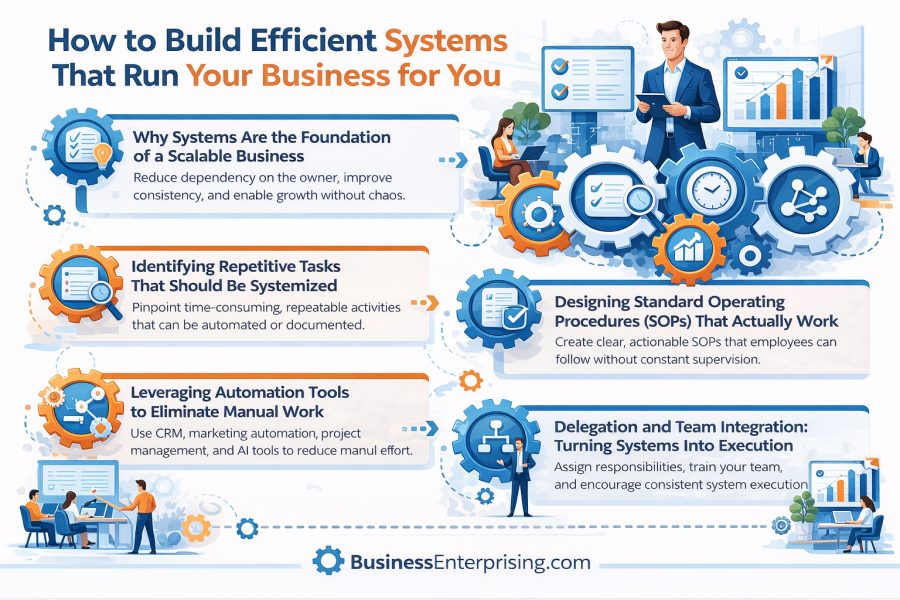
LEVERAGING AUTOMATION TOOLS TO ELIMINATE MANUAL WORK
Automation plays a key role in improving efficiency across your business. Therefore, using the right tools can save you significant time. When you understand how to build efficient systems, automation becomes a powerful asset.
At first, identify tasks that involve repetitive data entry or communication. These tasks often benefit from automation tools. Because of this, you can reduce manual effort and improve accuracy.
Moreover, customer relationship management platforms help organize client interactions. These systems track communication and streamline follow ups. As a result, your sales and service processes become more efficient.
In addition, marketing automation tools manage email campaigns and lead nurturing. When these processes run automatically, your team can focus on strategy. Therefore, your marketing efforts become more effective.
At the same time, project management platforms improve task organization and collaboration. These tools help your team stay aligned and meet deadlines. Because of this, productivity increases across your business.
Furthermore, AI driven tools can assist with content creation and data analysis. These technologies support faster decision making and execution. Consequently, your operations become more streamlined.
Over time, automation reduces the need for manual work in many areas. When tasks run automatically, your team can focus on higher value activities. As a result, your business becomes more efficient and scalable.
DELEGATION AND TEAM INTEGRATION: TURNING SYSTEMS INTO EXECUTION
Systems only work when your team follows them consistently. Therefore, delegation becomes a key part of your process. When you apply how to build efficient systems, you must integrate them into your team structure.
At first, assign clear responsibilities to each team member. Everyone should understand their role within each system. Because of this, accountability improves across your organization.
Moreover, provide training that focuses on both tasks and processes. When your team understands the system, execution becomes easier. As a result, performance improves without constant supervision.
In addition, encourage feedback from your team about existing systems. They often identify areas for improvement that you may overlook. Therefore, your systems evolve based on real experience.
At the same time, monitor how well systems are being followed. Regular check ins help maintain consistency and address issues quickly. Because of this, your operations remain stable.
Furthermore, create a culture that values structure and efficiency. When your team respects systems, they follow them more consistently. Consequently, your business operates more smoothly.
Over time, effective delegation reduces your direct involvement in daily tasks. When your team executes systems properly, you gain more freedom. As a result, you can focus on growth and leadership.
MONITORING, OPTIMIZING, AND SCALING YOUR SYSTEMS OVER TIME
Building systems is only the beginning of improving your business. Therefore, ongoing evaluation is necessary for long term success. When you focus on how to build efficient systems, continuous improvement becomes essential.
At first, track key performance indicators related to each system. These metrics show how well your processes perform. Because of this, you can identify areas that need adjustment.
Moreover, review your systems regularly to find inefficiencies. Over time, processes may become outdated or less effective. As a result, updates help maintain strong performance.
In addition, gather feedback from your team about system performance. Their insights often reveal practical improvements. Therefore, your systems become more effective over time.
At the same time, test new approaches to improve efficiency. Small changes can lead to meaningful results. Because of this, your business continues to evolve.
Furthermore, prepare your systems for growth by increasing capacity. As your business expands, your processes must handle higher demand. Consequently, scalability becomes part of your system design.
Over time, optimization creates a stronger operational structure. When your systems improve continuously, your business becomes more resilient. As a result, you maintain efficiency while supporting long term growth.
Q&A
| Question | Answer |
|---|---|
| What are business systems and why do they matter? | Business systems are structured processes that guide how tasks are completed. They matter because they create consistency, reduce errors, and allow your business to operate without constant supervision. As a result, you gain more control and can focus on growth rather than daily operations. |
| How do I start building systems in my business? | Start by reviewing your daily tasks and identifying repetitive activities. Then, document each step clearly and organize them into simple processes. Over time, refine these processes to improve efficiency. This approach helps you gradually build systems that support long term success. |
| What tools help automate business systems? | Tools like CRM platforms, email marketing software, and project management systems can automate many tasks. These tools handle communication, organization, and tracking. As a result, your team spends less time on manual work and more time on strategic activities. |
| How to build efficient systems without a large team? | You can start small by focusing on your own tasks first. Document your processes and use automation tools where possible. As your business grows, you can delegate these systems to new team members. This method allows you to scale efficiently without needing a large team immediately. |
| How often should business systems be updated? | You should review your systems regularly, ideally every few months. As your business changes, your processes may need adjustments. Regular updates help maintain efficiency and keep your operations aligned with your goals. This approach supports long term growth and stability. |