 You are likely hearing more about AI tools that can replace employees across many industries. Businesses now rely on automation to improve efficiency and reduce labor costs. As a result, you face growing pressure to understand how these tools affect your operations. While many companies adopt AI quickly, you still need to evaluate its real impact.
At the same time, you may notice that routine tasks no longer require human input. Instead, software now handles communication, data processing, and even decision support. Because of this shift, you can streamline operations without expanding your workforce. However, you must also consider how these changes affect quality and control.
Moreover, AI adoption continues to expand across departments, not only in technical roles. You can now automate marketing, sales, and administrative work with minimal oversight. As a result, businesses of all sizes can compete with fewer employees. Still, you need a clear strategy to use these tools effectively.
In many cases, you may find that AI improves speed and consistency across your processes. Yet, you should not assume it replaces every role completely. Instead, you should view AI as a way to handle repetitive work while you focus on growth. Ultimately, you must decide how AI fits into your business model. When you understand its capabilities, you can make smarter decisions about staffing and operations.
Customer Service Automation with AI Chatbots
You can now automate large portions of customer service using AI chatbots and virtual assistants. These tools respond to inquiries instantly and handle support requests at any time. As a result, you reduce wait times and improve customer satisfaction across your channels.
In many cases, you will see chatbots manage common questions without human involvement. Because of this, your support team can focus on more complex issues. Furthermore, AI tools learn from past interactions and improve responses over time.
You may also notice cost savings when you replace repetitive support tasks with automation. Since chatbots operate continuously, you do not need to scale staff during peak periods. Instead, you maintain consistent service without increasing payroll expenses.
Moreover, AI tools can integrate with your website, messaging platforms, and CRM systems. This allows you to deliver a unified customer experience across all touchpoints. As a result, you strengthen your brand while reducing manual effort.
When you implement AI tools that can replace employees in customer service, you gain both speed and consistency. However, you still need human oversight for complex or sensitive interactions.
AI in Content Creation and Copywriting
You can now produce written content faster using AI-driven writing tools. These platforms generate blog posts, social media updates, and product descriptions within minutes. As a result, you maintain a steady flow of content without expanding your team.
In many situations, you will find that AI helps you scale your marketing efforts efficiently. Because it handles repetitive writing tasks, you can focus on strategy and messaging. Furthermore, AI tools can adjust tone and structure based on your needs.
You may also reduce costs when you rely on automation for high-volume content production. Instead of hiring multiple writers, you can use AI to support your existing team. This allows you to allocate resources more effectively.
At the same time, you should review AI-generated content before publishing. While it produces readable text, it may lack depth or originality in some cases. Therefore, your input remains important for maintaining brand voice.
When you adopt AI tools that can replace employees in content creation, you gain speed and flexibility. Still, you must guide the output to align with your business goals.
Automating Administrative and Back-Office Tasks
You can streamline administrative work by using AI tools to handle routine processes. These tools manage scheduling, email organization, and data entry with minimal input. As a result, you reduce the need for manual labor in back-office roles.
In many cases, you will notice improved accuracy when AI handles repetitive tasks. Because it follows consistent rules, it reduces errors that often occur with manual entry. This leads to more reliable data across your systems.
You may also find that automation improves workflow efficiency across departments. Since AI processes tasks quickly, you avoid delays that slow down operations. Furthermore, you can reassign staff to higher-value work.
Moreover, AI tools integrate with accounting and document management systems. This allows you to automate invoicing, reporting, and file organization. As a result, you maintain better control over your operations.
When you implement AI tools that can replace employees in administrative roles, you improve efficiency and accuracy. However, you still need oversight to manage exceptions and system updates.
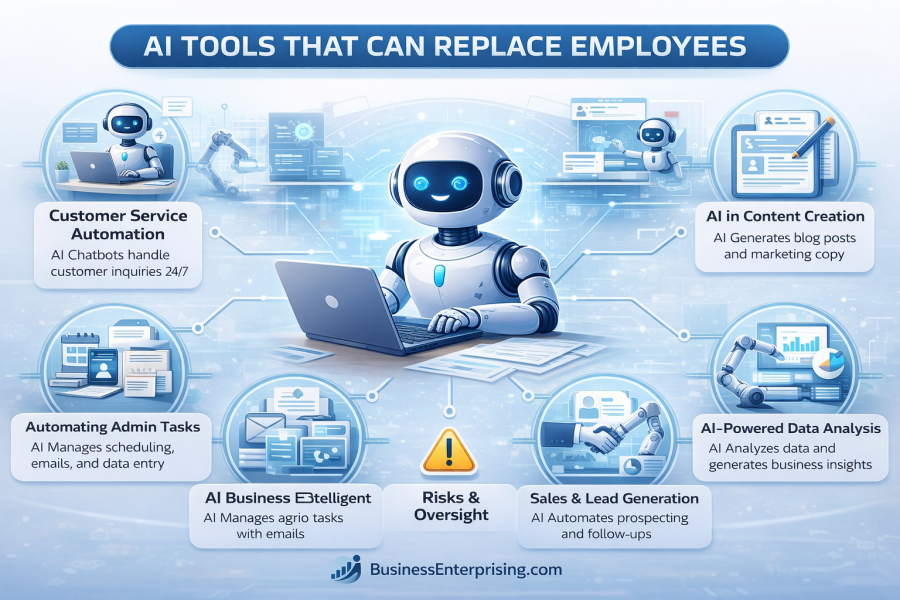
AI-Powered Data Analysis and Business Intelligence
You can process large amounts of data quickly using AI-driven analytics tools. These platforms identify patterns and generate insights without manual analysis. As a result, you make faster decisions based on real data.
In many situations, you will see AI produce reports that once required skilled analysts. Because of this, you reduce reliance on specialized staff for routine analysis. Furthermore, these tools update insights in real time.
You may also improve forecasting accuracy when AI evaluates historical trends. Since it processes more variables than humans, it can detect subtle patterns. This helps you plan more effectively for future growth.
Moreover, AI tools present data in clear visual formats that you can understand quickly. This allows you to act on insights without extensive interpretation. As a result, your decision-making becomes more efficient.
When you use AI tools that can replace employees in data analysis, you gain speed and precision. Still, you should review outputs to confirm they align with your business context.
Sales and Lead Generation Automation
You can automate many parts of your sales process using AI-driven tools. These platforms identify prospects, send outreach messages, and track engagement. As a result, you maintain consistent communication without manual effort.
In many cases, you will see AI personalize messages based on customer data. Because of this, your outreach feels relevant and timely. Furthermore, automation ensures that no lead goes unnoticed.
You may also improve conversion rates when AI manages follow-ups and scheduling. Since it responds quickly, you reduce delays that often lead to lost opportunities. This keeps your sales pipeline active.
Moreover, AI tools integrate with CRM systems to organize and update lead information. This allows you to track performance and adjust strategies easily. As a result, your sales efforts become more efficient.
When you adopt AI tools that can replace employees in sales tasks, you scale outreach effectively. However, you still need human involvement for closing deals and building relationships.
The Risks, Limitations, and Human Oversight Required
You should recognize that AI cannot fully replace human judgment in every situation. While it handles repetitive tasks well, it lacks emotional understanding and context awareness. As a result, you must monitor how it interacts with customers.
In many cases, you will find that AI struggles with complex decisions. Because it relies on data patterns, it may not adapt well to unusual scenarios. Therefore, human input remains necessary for critical tasks.
You may also encounter ethical concerns when using automation in your business. Since AI processes sensitive data, you must protect privacy and maintain transparency. This helps you build trust with your audience.
Moreover, you need to review outputs regularly to avoid errors or misleading results. Although AI improves efficiency, it can still produce inaccurate information. As a result, oversight becomes an ongoing responsibility.
When you implement AI tools that can replace employees, you should maintain a balanced approach. You gain efficiency through automation while preserving human control where it matters most.

FAQ
| Question | Answer |
|---|---|
| What types of jobs can AI replace most easily? | AI typically replaces repetitive, rule-based roles such as data entry, customer support, and basic content creation. These tasks follow predictable patterns, which makes them easier to automate. However, roles requiring creativity, emotional understanding, or complex judgment still rely heavily on human input. |
| Are AI tools expensive to implement? | Costs vary depending on the tool and scope of use. Many platforms offer scalable pricing, which allows you to start small and expand over time. While there is an upfront investment, businesses often reduce long-term labor costs and improve efficiency, which can offset initial expenses. |
| Can AI fully replace human employees? | AI can handle many tasks independently, yet it does not replace every function within a business. Human oversight remains important for decision-making, strategy, and relationship building. Most companies benefit from a hybrid model that combines automation with human expertise for better results. |
| How do AI tools improve business productivity? | AI tools process tasks faster and with greater consistency than manual workflows. They reduce errors, eliminate delays, and operate continuously without downtime. As a result, you can complete more work in less time while focusing your efforts on growth and strategic initiatives. |
| Are AI tools that can replace employees safe to use? | AI tools that can replace employees are generally safe when used correctly. You need to monitor data handling practices and review outputs regularly. By maintaining oversight and using trusted platforms, you can reduce risks while benefiting from improved efficiency and automation. |