 You need strong time management strategies to scale your business without losing focus or momentum. As your company grows, your responsibilities expand, and your time becomes more limited. Therefore, how you manage each hour directly impacts your results and long term progress. While many entrepreneurs stay busy, not all activity drives meaningful growth.
Instead, you must focus on using your time with purpose and clarity. As a result, you can move from reactive work toward intentional action that supports expansion. Meanwhile, poor time habits can slow growth and create unnecessary stress. Because of this, you need a structured approach that aligns your daily actions with your business goals.
In many cases, entrepreneurs try to do everything themselves, which limits scalability. However, growth requires a shift in how you allocate your attention and energy. By refining your daily routines, you can create more space for strategic thinking and leadership. At the same time, you reduce distractions that pull you away from high value work.
So, when you apply smarter methods, you gain control over your schedule and output. Then, you can build systems that support consistent progress without constant overwhelm. Ultimately, effective time management allows you to operate at a higher level while maintaining clarity and direction.
Identifying High-Impact Activities That Drive Business Growth
To scale effectively, you must identify which tasks truly move your business forward. Many entrepreneurs stay busy with low value work that creates little impact. As a result, their time gets consumed without producing meaningful outcomes. Therefore, you need to separate activity from productivity.
First, you should evaluate how each task contributes to revenue or growth. Then, you can prioritize work that directly influences results. Meanwhile, administrative tasks often take up time without driving progress. Because of this, you must limit their role in your daily schedule.
In contrast, high impact activities often involve strategy, sales, and decision making. These tasks require focus and should receive your best energy. At the same time, you should track where your time goes each day. This helps you spot patterns and eliminate inefficiencies.
As you refine your approach, your time management strategies become more aligned with your goals. Then, you can focus on actions that create measurable progress. Over time, this shift leads to better results with less wasted effort.
Ultimately, your growth depends on how you allocate your time. When you focus on what matters most, your business can expand with greater clarity and direction.
Leveraging Time Blocking to Maintain Focus and Productivity
Time blocking helps you structure your day with clear intention and focus. Instead of reacting to tasks, you plan when each activity will happen. As a result, you reduce distractions and improve your ability to complete important work.
First, you divide your day into dedicated blocks for specific tasks. Then, you assign priority work to your peak energy hours. Meanwhile, smaller tasks can fit into shorter time slots. Because of this structure, your schedule becomes more predictable and controlled.
In addition, time blocking reduces the constant switching between tasks. This improves concentration and allows deeper work. At the same time, it limits interruptions that can break your momentum. Over time, this approach strengthens your discipline and consistency.
As you apply time management strategies like this, your productivity becomes more stable. Then, you can complete more meaningful work in less time. This also creates space for planning and strategic thinking.
Furthermore, you should review your schedule regularly and adjust as needed. This keeps your system flexible while maintaining structure. Ultimately, time blocking helps you stay focused on what matters most while reducing unnecessary stress.
Delegation Strategies to Free Up Founder-Level Time
As your business grows, you cannot handle every task on your own. Therefore, delegation becomes a key part of scaling effectively. By transferring responsibilities, you create more time for leadership and strategic decisions.
First, you should identify tasks that do not require your direct involvement. Then, you can assign those responsibilities to capable team members or external partners. Meanwhile, you maintain oversight without managing every detail. This allows you to stay focused on high level priorities.
In addition, clear communication plays a major role in successful delegation. You must define expectations, outcomes, and timelines. As a result, your team can perform tasks with confidence and accuracy. Over time, this builds trust and improves efficiency.
When you use time management strategies that include delegation, your workload becomes more balanced. Then, you can spend more time on growth initiatives and planning. This shift allows your business to operate without constant dependence on you.
Furthermore, delegation supports team development and accountability. Your team gains experience while contributing to business growth. Ultimately, effective delegation allows you to scale without becoming overwhelmed by daily operations.
Using Automation Tools to Eliminate Repetitive Tasks
Automation allows you to reduce time spent on repetitive and manual tasks. As a result, you can focus on higher value activities that support growth. Many processes in business can run without constant human input.
For example, marketing platforms can schedule posts and manage campaigns automatically. Meanwhile, customer service tools can handle common inquiries. Because of this, you save time while maintaining consistency. Over time, these systems improve efficiency across your operations.
In addition, automation reduces the risk of human error in routine tasks. This leads to more reliable outcomes and smoother workflows. At the same time, it frees your mental energy for strategic thinking. As your business expands, this becomes increasingly important.
When you incorporate automation into your time management strategies, your workload becomes more manageable. Then, you can focus on activities that require creativity and decision making. This creates a better balance between execution and planning.
Furthermore, you should review your systems regularly to improve performance. This helps you refine your processes and remove inefficiencies. Ultimately, automation supports scalability by reducing unnecessary effort and improving consistency.
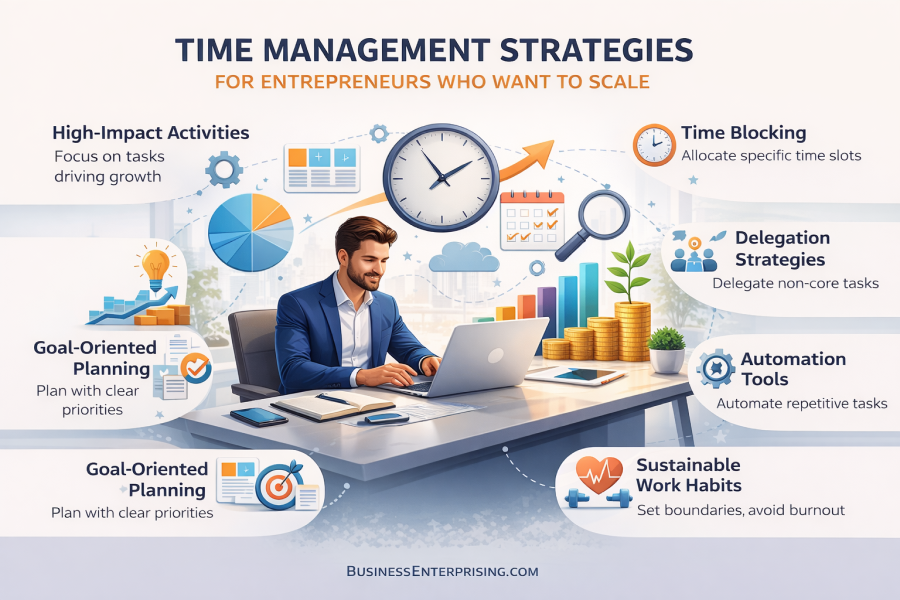
Setting Clear Priorities with Goal-Oriented Planning Systems
Clear priorities help you stay focused on what drives growth and progress. Without structure, your time can easily become scattered across tasks. Therefore, goal oriented planning provides direction and clarity.
First, you should define your long term objectives and break them into smaller milestones. Then, you can align your daily tasks with those goals. Meanwhile, this approach keeps your actions consistent with your overall strategy. Over time, this creates steady progress.
In addition, frameworks like quarterly planning help you stay organized. You can track results and adjust your approach as needed. At the same time, daily prioritization keeps you focused on immediate actions. This balance supports both short term and long term growth.
When you apply time management strategies based on clear priorities, your decisions become more intentional. Then, you can avoid distractions that do not support your goals. This leads to better use of your time and resources.
Furthermore, regular reviews help you stay aligned with your objectives. You can identify gaps and improve your approach. Ultimately, clear planning systems allow you to work with purpose and direction.
Avoiding Burnout While Scaling Through Sustainable Work Habits
Scaling a business requires consistent effort, yet you must protect your energy. Without balance, long hours can lead to burnout and reduced performance. Therefore, sustainable work habits support long term success.
First, you should set boundaries around your work schedule. This helps you maintain focus during working hours and recover afterward. Meanwhile, regular breaks improve concentration and reduce fatigue. Over time, this leads to better productivity.
In addition, managing your energy is as important as managing your time. You need rest, movement, and mental clarity to perform at your best. As a result, you can sustain high performance without exhaustion.
When you include wellness in your time management strategies, your output becomes more consistent. Then, you can handle growth without sacrificing your well being. This balance allows you to maintain focus and clarity.
Furthermore, you should recognize early signs of burnout and adjust your workload. This prevents long term setbacks and keeps you on track. Ultimately, sustainable habits allow you to scale your business while maintaining your health and performance.

FAQ
| Question | Answer |
|---|---|
| What are the most effective ways to manage time as an entrepreneur? | Effective time management starts with clear priorities, structured scheduling, and consistent review of tasks. You should focus on high impact work and reduce distractions. Over time, systems like time blocking and delegation help create better control over your schedule and improve productivity. |
| How can I tell if I am spending time on the right tasks? | You should evaluate whether your tasks contribute to revenue, growth, or strategic goals. If they do not, they may be low value. Tracking your daily activities helps you identify patterns and adjust your focus toward more meaningful work. |
| Why is delegation important for business growth? | Delegation allows you to shift routine tasks to others, which frees your time for leadership and planning. As your team takes on responsibilities, your business becomes less dependent on your direct involvement and can operate more efficiently. |
| How do time management strategies support scaling a business? | Time management strategies help you allocate your effort toward activities that drive growth. They reduce wasted time, improve focus, and create structure. As a result, you can handle increased responsibilities while maintaining clarity and consistent progress. |
| What role does automation play in saving time? | Automation reduces manual effort by handling repetitive tasks like scheduling, communication, and data processing. This allows you to focus on more complex work. Over time, automated systems improve efficiency and help your business operate with greater consistency. |