 AI continues to reshape how companies operate and grow. Many leaders now explore AI Uses for Business to gain a competitive edge. However, most discussions focus on obvious applications like chatbots and automation. As a result, many powerful opportunities remain overlooked.
While common tools improve efficiency, deeper AI capabilities drive smarter decisions. Therefore, businesses that explore less visible uses often gain stronger results. You can move beyond basic automation and tap into predictive and strategic insights. Moreover, these insights often come from data you already collect daily.
Because markets change quickly, you need faster and better decision support. AI helps you analyze patterns that human teams often miss. In addition, it allows you to act before problems become visible. This shift changes how you approach growth, risk, and customer relationships.
At the same time, many businesses hesitate due to complexity concerns. However, modern AI tools have become more accessible and practical. So, you can start applying advanced strategies without massive technical investment. As a result, even smaller teams can compete with larger organizations.
Instead of focusing on trends, you should focus on impact. AI offers ways to improve revenue, reduce inefficiencies, and strengthen customer engagement. Therefore, understanding lesser-known applications gives you a real advantage.
In the following sections, you will explore powerful yet underused AI strategies. Each one can transform how you think about growth and operations. More importantly, each approach helps you act with greater clarity and confidence.
AI for Predicting Customer Churn Before It Happens
Customer churn often appears sudden, yet patterns usually develop over time. AI Uses for Business allow you to detect these patterns early. By analyzing behavior signals, AI identifies customers likely to leave soon.
For example, AI tracks engagement drops, purchase frequency changes, and support interactions. As a result, you gain insight before customers fully disengage. You can then respond with targeted offers or outreach.
Moreover, AI models learn from past churn cases. Therefore, predictions improve as more data becomes available. You move from reactive responses to proactive retention strategies. This shift reduces revenue loss significantly.
In addition, AI segments customers based on risk levels. You can prioritize high-value clients who show early warning signs. Consequently, your team focuses efforts where they matter most.
Because churn often hides in subtle data shifts, manual analysis falls short. AI highlights patterns that human teams rarely notice. This visibility helps you act earlier and more effectively.
At the same time, personalized retention strategies become easier to execute. AI recommends messaging, timing, and incentives for each customer. As a result, your outreach feels relevant and timely.
Ultimately, predicting churn changes your entire customer strategy. You stop reacting to losses and start preventing them. That shift directly impacts long-term growth and profitability.
Using AI to Reverse-Engineer Competitor Strategies
Understanding competitors often relies on guesswork. However, AI Uses for Business allow you to analyze their strategies with precision. By processing large data sets, AI reveals patterns behind their success.
For instance, AI examines competitor content, keyword rankings, and advertising activity. As a result, you identify what drives their visibility and engagement. You gain insights that go beyond surface-level observations.
Moreover, AI tracks pricing changes and promotional trends over time. Therefore, you can detect strategic shifts before they become obvious. This awareness helps you respond faster and more effectively.
In addition, AI analyzes audience engagement across platforms. You learn which messages resonate with their customers. Consequently, you refine your own positioning with greater accuracy.
Because manual research takes time, many businesses miss critical signals. AI accelerates this process and improves depth of analysis. You gain a clearer picture without overwhelming your team.
At the same time, AI identifies gaps in competitor strategies. These gaps represent opportunities for differentiation and growth. You can position your brand more effectively in the market.
Ultimately, reverse-engineering competitor strategies provides a strategic advantage. You make informed decisions instead of relying on assumptions. That clarity leads to stronger positioning and better results.
AI-Powered Decision Simulation for Business Strategy
Strategic decisions often carry significant risk. However, AI Uses for Business allow you to simulate outcomes before acting. This approach helps you test ideas in a controlled environment.
For example, AI models can simulate pricing changes or market expansion. As a result, you see potential outcomes based on historical and real-time data. You reduce uncertainty in major decisions.
Moreover, AI considers multiple variables simultaneously. Therefore, it captures complexity that traditional analysis often misses. You gain a more complete view of possible scenarios.
In addition, decision simulation helps you compare different strategies. You can evaluate risks and rewards side by side. Consequently, you choose options with greater confidence.
Because business environments change quickly, static planning falls short. AI adapts models as new data becomes available. This flexibility keeps your strategy relevant and informed.
At the same time, simulation improves collaboration within your team. Stakeholders can review data-backed projections instead of opinions. This alignment strengthens decision-making processes.
Ultimately, AI-powered simulation shifts how you approach strategy. You move from uncertainty to informed experimentation. That shift reduces costly mistakes and supports sustainable growth.
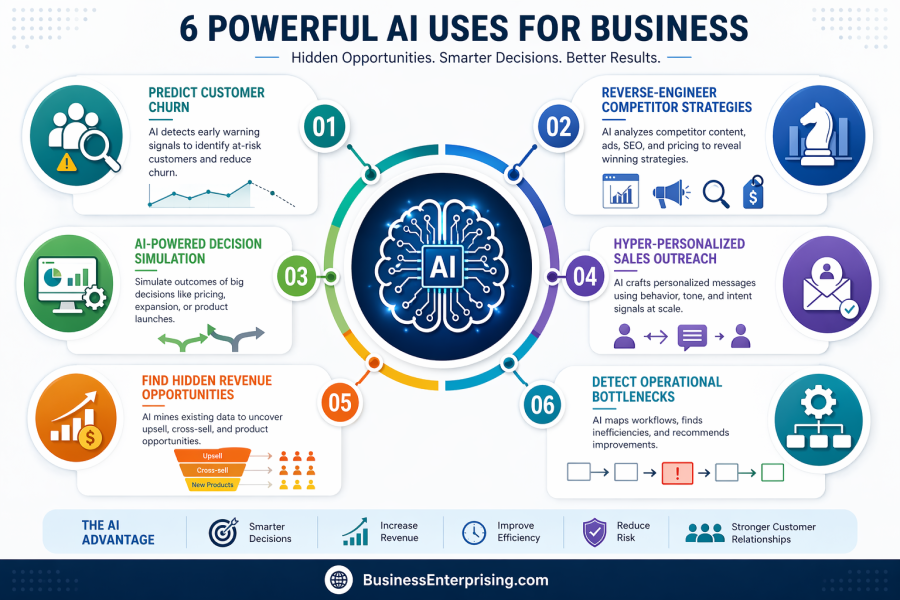
Hyper-Personalized Sales Outreach at Scale Using AI
Personalization often stops at basic details like names or industries. However, AI Uses for Business take personalization much further. AI analyzes behavior, preferences, and intent signals to craft tailored messages.
For instance, AI reviews browsing activity, past interactions, and engagement patterns. As a result, your outreach reflects real customer interests. This approach improves response rates significantly.
Moreover, AI adapts tone and messaging style based on recipient behavior. Therefore, communication feels natural and relevant. You build stronger connections with prospects.
In addition, AI enables personalization at scale. You can reach thousands of prospects without losing quality. Consequently, your sales efforts become both efficient and effective.
Because manual personalization takes time, many teams rely on generic messaging. AI removes this limitation and enhances targeting. You deliver value in every interaction.
At the same time, AI tracks performance and refines messaging continuously. Campaigns improve as the system learns from results. This ongoing optimization drives better outcomes over time.
Ultimately, hyper-personalized outreach changes how you engage prospects. You move from broad messaging to meaningful conversations. That shift increases conversions and strengthens relationships.
AI for Identifying Hidden Revenue Opportunities in Existing Data
Most businesses collect large amounts of data daily. However, much of that data remains underused. AI Uses for Business help you extract value from existing information.
For example, AI analyzes transaction history and customer behavior. As a result, it identifies upsell and cross-sell opportunities. You discover revenue potential that often goes unnoticed.
Moreover, AI detects patterns in product usage and preferences. Therefore, you can refine offerings based on real demand. This alignment improves customer satisfaction and sales.
In addition, AI highlights gaps in your current product or service mix. You gain insights for new development opportunities. Consequently, innovation becomes data-driven.
Because manual analysis limits depth, many insights remain hidden. AI processes large data sets quickly and accurately. You gain a clearer understanding of your business.
At the same time, AI supports more targeted marketing strategies. You reach customers with relevant offers at the right time. This precision improves conversion rates.
Ultimately, identifying hidden revenue opportunities transforms how you use data. You shift from passive collection to active monetization. That shift drives measurable growth.
Operational Bottleneck Detection Using AI Process Analysis
Operational inefficiencies often reduce performance without clear visibility. However, AI Uses for Business help you identify bottlenecks with precision. By analyzing workflows, AI reveals hidden constraints.
For instance, AI maps processes across departments and systems. As a result, you see where delays and inefficiencies occur. This visibility helps you act quickly.
Moreover, AI evaluates process performance in real time. Therefore, you can detect issues as they develop. You avoid prolonged disruptions and lost productivity.
In addition, AI recommends improvements based on data patterns. You receive actionable insights for streamlining operations. Consequently, your processes become more efficient.
Because teams often rely on assumptions, inefficiencies persist. AI replaces guesswork with data-driven analysis. You gain clarity on what needs improvement.
At the same time, AI helps you measure the impact of changes. You can track performance improvements over time. This feedback supports continuous optimization.
Ultimately, detecting operational bottlenecks improves overall performance. You reduce waste, increase efficiency, and support growth. That improvement strengthens your competitive position.

FAQ
| Question | Answer |
|---|---|
| How can small businesses start using AI effectively? | Small businesses can begin by applying AI tools to specific problems like customer retention or marketing optimization. Start with existing data and simple platforms. Over time, expand usage as you gain confidence and measurable results from early efforts. |
| Is AI only useful for large companies with big budgets? | AI has become more accessible and affordable in recent years. Many tools now offer scalable pricing and easy integration. As a result, smaller businesses can use AI to improve operations, marketing, and decision-making without major investment. |
| What is the biggest advantage of using AI in business? | AI provides faster insights and better decision support. It analyzes large data sets and identifies patterns humans often miss. This ability allows businesses to act earlier, reduce risk, and improve performance across multiple areas. |
| How does AI help increase revenue? | AI identifies hidden opportunities in customer data, purchasing patterns, and market behavior. For example, AI Uses for Business include finding upsell opportunities and improving targeting. These insights help increase conversions and customer value over time. |
| What risks should businesses consider when adopting AI? | Businesses should consider data quality, privacy, and implementation strategy. Poor data leads to inaccurate insights. Clear goals and proper oversight help reduce risk and improve outcomes when integrating AI into operations. |